
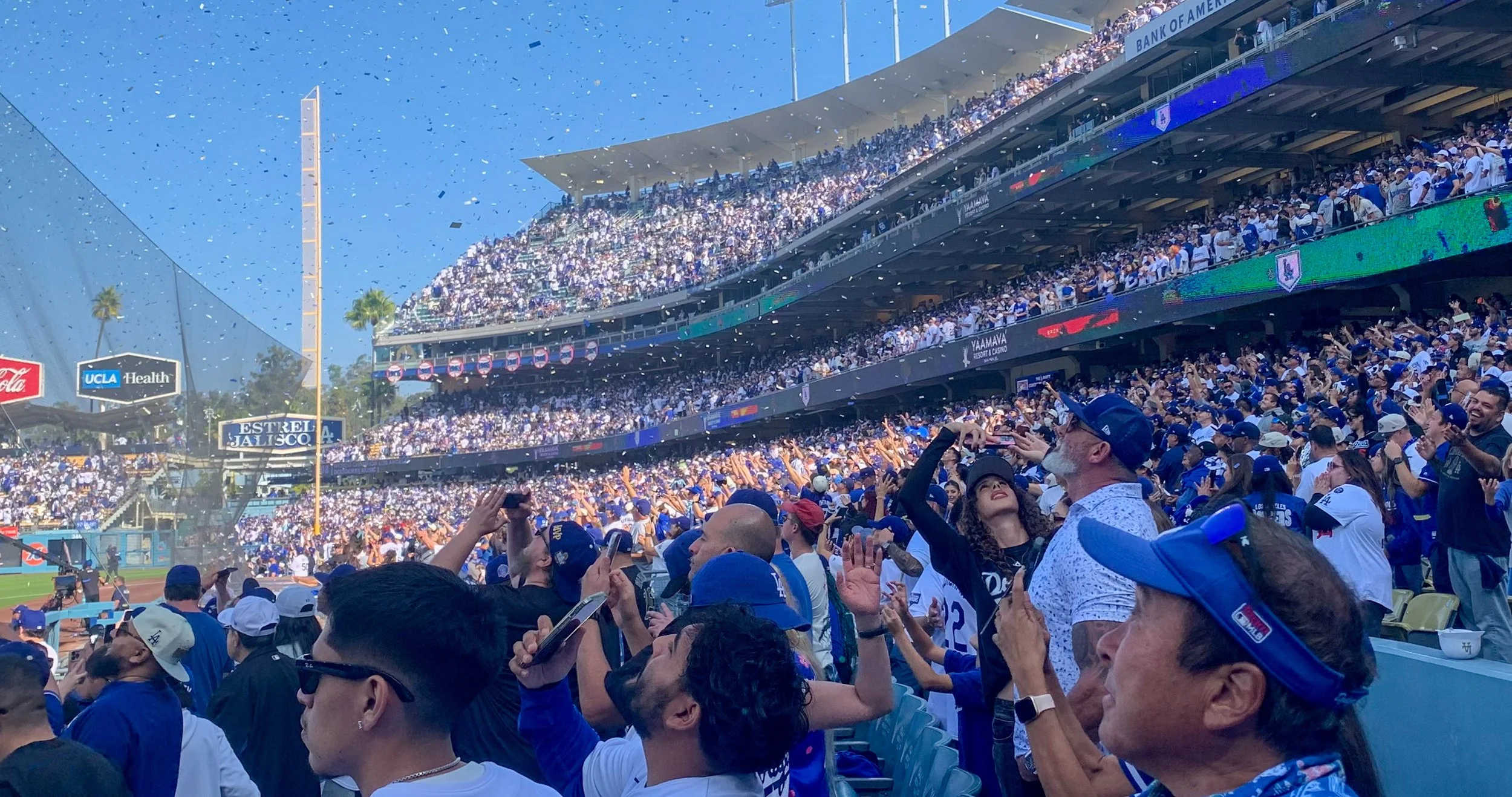
Now that the dust has settled and it's been a couple weeks since the World Series ended, I have found myself with open evenings that were once filled with baseball, but now are filled with reflecting on the 2025 MLB season — specifically the Los Angeles Dodgers’ 2025 season. This was the first season that I followed from beginning to end.
During the 2024 offseason, the Dodger lineup looked promising with free-agency signings like Blake Snell, Tanner Scott, Kirby Yates, Michael Conforto, Hyesong Kim and Roki Sasaki. The team looked unstoppable in the beginning of the 2025 season. With these players being added to an already stacked lineup, it looked like the Dodgers would run away with the trophy. But in reality, the Dodgers’ 2025 season would be a roller coaster with the highest of highs and the lowest of lows.
First stop of the season was Japan, where the Dodgers had two exhibition games against two teams from the NPB (Nippon Professional Baseball) league: the Hanshin Tigers and the Yomiuri Giants. The Dodgers lost to the Tigers 3-0 but defeated the Giants 5-1. To start their regular season, the Dodgers had two games against the Chicago Cubs in the Tokyo Dome, a familiar scene for Japanese players on both teams. The Dodgers took both games in Japan, with scores of 4-1 and 6-3.
The season opened much like it looked on paper: the Dodgers dominating, but not without some struggle. With the pitching line up looking terrifying, the one thing that weakened it was injuries. Tyler Glasnow, Tony Gonslin, Sasaki and Snell all went on the injured list early in the season.
The pitching rotation at the beginning of the season consisted of Snell, Yoshinobu Yamamoto, Sasaki, Glasnow and Dustin May — a healthy five man rotation. But by June, it had shifted to Yamamoto, Clayton Kershaw (who came back after a toe injury in 2024), May, and then bullpen games, where relievers pitched an inning or two to cover a full game so the starters could have a day to rest. The Dodgers went from a five-man rotation to a three-man rotation—four, when counting the bullpen games.
While the situation looked bleak, reinforcements eventually came as pitchers were returning from injuries. As mentioned earlier, Kershaw rejoined the rotation in May after recovering from a toe injury and still pitched well in his eighteenth year in the majors. In June, Emmet Sheehan came back from Tommy John surgery. A surgery named after the first baseball player to get this type of surgery Thomas Edward John Jr. back in 1974—a procedure where your UCL is reconstructed and is scary for pitchers because it is a gamble if they can ever return and pitch like they used to before the surgery. Fortunately for the Dodgers, pitchers have come out of the surgery and done well, like Sheehan, who helped out the Dodgers rotation.
Shohei Ohtani also returned to the mound in June. Like Sheehan, Ohtani had also undergone Tommy John surgery. Ohtani’s story is special because yes he could hit homeruns like nothing, but this was his second Tommy John surgery, and there was some doubt if he could return to how he was with the Los Angeles Angels. When Ohtani came back to the mound and was still able to throw 100 mph, it made his $700 million contract look like he was being underpaid.
The Dodgers finished the regular season with a 93-69 record, which isn't bad, but it begs the question: why were they losing games? Well there's a lot of reasons, one big one being that the timing was never right. When the bats were hot, the pitching couldn't keep up — and when the pitching performed well, the bats often went cold and asleep.
There was a noticeable pattern during the season: the Dodgers consistently struggled against pitchers with high ERAs — something a “super team” like the Dodgers shouldn't be doing. Another low point came when the Dodgers were swept twice by the Angels, once at home and once in Anaheim. In all six games, the Angels came away with the win.
Conforto, a free-agent signing who looked promising early on, began to look lost at the plate. Although he had a few bright moments, they were overshadowed by long stretches of poor performance. He ended the season with a .199 batting average, which isn't great, and because of that, Conforto was not included on the playoffs roster..
Mookie Betts also struggled for much of the season, but was able to turn it around toward the end. Betts missed the games in Japan due to illness, and when he returned to play, he had lost 20 pounds. On top of that, he was also learning a new position, moving from his usual spot in right field to shortstop. The illness, weight-loss and position change are some reasons fans speculated why he didn't have his best year at the plate. Even so, Betts made up for it with great defensive plays— and despite everything, he still had key moments, including a clutch hit in game six of the World Series which helped secure the Dodgers win.
Another reason for the Dodgers’ record was the bullpen. The relievers had a lot on their plate, making regular appearances to support starters, and having to pitch a full game leading to an overused bullpen. So when they had to make those regular appearances, they were not at 100 percent. But this problem didn't seem to go away after the pitching was back to a five man rotation.
You can see this reflected in Yamamoto’s stats. Out of his 30 starts, he won 12 and lost eight, but ended the year with a 2.49 ERA, which landed him third place in National League Cy Young voting, an award given to the best pitcher in MLB. While Yamamoto did have his bad days, there were times when the offense or bullpen couldn’t back him up.
The bullpen was a real problem toward the end of the season. One game that immediately comes to mind was on Sept. 6 against the Baltimore Orioles. Yamamoto had a fantastic start to the game, going almost nine full innings without allowing a single hit, but that came to an end after a home run from Jackson Holiday. With the score 3-1, out went Yamamoto and in came the bullpen, only needing to get one more out..
Blake Treinen came in and immediately allowed a double, hit a batter, and walked another. It went from bases empty with two outs to bases loaded, still with two outs. Treinen then walked another batter, cutting the Dodgers’ lead to 3-2. Dodgers’ manager Dave Roberts pulled Treinen out of the game and brought in free-agent pickup Tanner Scott. Scott allowed two more runs to score, blowing the lead and giving Baltimore a 4-3 win.
After that game, I didn't watch the Dodgers for a week. It felt so bizarre then that the Dodgers lost that game and still does now. But it wasn't just Treinen and Scott struggling— Kirby Yates, another free-agent reliever, also didn't have the best year. By the end of the regular season,the entire bullpen felt unreliable, and with playoffs so near, fans were worried about how the group would perform.
But the playoffs are where legends are born. Will Klein and his amazing performance during Game 3 of the World Series, and Miguel Rojas— one swing of his bat solidifying him as a Dodgers legend in game 7. Sasaki was another legend. The pitcher who struggled his first couple of starts went to the injured list and went to the minor leagues to work on his pitching. Fans were confused on what role Sasaki was going to play in the playoffs, some saying he shouldn't play and just wait for the next season. All talk was shut down when Sasaki came out of the bullpen to close a game against the Cincinnati Reds, pitching a clean inning. He continued closing throughout the playoffs, greeted by fans cheering for him when he stepped on the mound. It was a true comeback arc: from struggling in the early season to being the player fans relied on to close out games.
The season also delivered big milestones. One of the biggest was Kershaw’s 3,000th career strikeout, which was a perfect storybook moment. Facing the Chicago White Sox, Kershaw only needed three strikeouts to reach 3,000, but the White Sox made Kershaw work for it, with him finally reaching the milestone on his 100th pitch in the sixth inning. The Dodgers were losing that game 4-2, but still managed to win via a Freddie Freeman walk-off single to finish the game 5-4.
Another comeback story belonged to Max Muncy. Muncy started his season in a slump, but his teammates never stopped backing him up. When he finally hit his first homerun, the Dodgers’ dugout erupted, and Freeman threw his hands up in relief. After getting a pair of glasses, Muncy started to look like his old self again. Just as things were turning around, he suffered a nasty injury in July during Kershaw’s 3,000-strikeout game against the White Sox. It looked like Muncy would be out for a good chunk of the season, but in August a month later, Muncy was back to playing, smacking two home runs in his second game back.
Fans also witnessed probably one of the best playoff performances by one player in game 4 of the NLCS, when Shohei Ohtani struck out 10 batters and hit three home runs. Ohtani’s return to pitching was one of the most anticipated storylines after it was announced he was signing to the Dodgers, especially since he had never gotten the chance to pitch in the playoffs with the Angels. While Ohtani had pitched in high leverage situations like the World Baseball Classic, the MLB playoffs are just different and this would be his first time to show off how good his pitching is. While it's impressive he was able to strike out 10 batters, the fact that every at-bat he hit a homerun was just crazy. These home runs were no doubters, meaning it’s a home run in every MLB stadium, and this game being the one to send the Dodgers to the World Series made it even sweeter.
In the end, the Dodgers cemented their dynasty, winning back-to-back World Series titles in 2024 and 2025. Kershaw retired a three-time champion and a likely first-ballot Hall of Famer. Ohtani delivered another amazing season and earned the National League MVP. Will Smith had some magical moments including his walkoff homer against the Padres, and Yamamoto showed why he's a pitcher worth $325 million dollars with his dominant performance in the playoffs.
But soon, it will be time for opening day and the start of the 2026 MLB season, as the Dodgers aim for a three-peat — three championships in three years.