
SMCPD Details its Military Weapons Stockpiles
The Santa Monica College Police Department recently released its annual AB481 Military Weapons Report, detailing the department's current military-grade equipment.
According to the 2026 report, SMCPD is required to “obtain approval from their governing body—through a resolution and military equipment use policy—before acquiring, funding, or using military equipment. AB 481 requires annual re-approval of the policy and a public report detailing how the equipment was used, associated costs, any complaints or violations, and audit results.”
The seven-member Santa Monica Community College District Board of Trustees approved SMCPD’s 2026 report during their meeting on Tuesday, Sept. 8. The report documented no new weapons purchases and zero instances of equipment use, actions taken, violations or complaints.
California Assembly Bill 481, signed into law by Gov. Gavin Newsom in 2021, went into effect at the start of 2022. The bill creates and outlines the policies campus police must follow when seeking approval for acquiring, using and reporting on inventories of 15 specified categories of military-style equipment.
Many college and university police departments deem military-grade equipment necessary to protect students, faculty and facilities against threats of violence.
According to the State University of New York’s Rockefeller Institute of Government, from 2000 to 2022, the United States experienced three times as many school mass shootings than the 35 economically and politically comparative countries behind it.
SMC is no stranger to on-campus gun violence.
This past Wednesday marked the second anniversary of the October 14, 2024, fatal shooting of Felicia Hudson, a 54-year-old custodial operations manager, by custodian Davon Durell Dean, 39, at the college’s Center for Media and Design. Dean fled the scene and died from a self-inflicted gunshot wound the following day during a standoff with police.
The 2024 incident wasn’t the first fatal shooting at SMC.
On June 7, 2013, former SMC student, 23-year-old John Zawahri shot and killed his father and brother at their home before setting the house on fire, hijacking a vehicle and firing at random targets, including a Big Blue Bus and a police cruiser.
Zawahri, armed with an AR-15-style rifle and a .44-caliber revolver, made his way onto the SMC campus, where he fired at a Ford Explorer, killing the driver, school groundskeeper Carlos Navarro Franco, 68, and his daughter, Marcela Diaz Franco, 26. She succumbed to her injuries two days later.
He then went to the SMC library, where he shot and killed Margarita Gomez, 68, who was collecting recyclable materials just outside the library doors.
Upon entering the library, Zawahri began firing at students who barricaded themselves in a room. Santa Monica Police and off-duty SMCPD Sgt. Raymond Bottenfield arrived on scene and exchanged gunfire with Zawahri inside the library, striking him 25 times, according to the Los Angeles County district attorney report. Zawahri died at the scene.
In addition to gun violence, many colleges have seen a wave of protests in recent years related to the Israel-Palestine conflict and Immigration and Customs Enforcement actions throughout the nation.
With campus police often among the fastest on scene of such incidents, due to their proximity, many campus police have had to rethink their preparedness to combat these incidents.
Today, SMCPD is aided by a new radio system using the LA-RICS network. According to the network’s website, “the Los Angeles Regional Interoperable Communications System (LA-RICS) will vastly improve radio communication for police, firefighters, paramedics and other emergency responders in Los Angeles County.”
The system allows for multi-jurisdiction communication, helping SMCPD receive early alerts to threats that might make their way onto campus from other jurisdictions.
With radios being early warning systems for potential threats, SMCPD is prepared to confront those threats with both lethal and non-lethal military-grade equipment.
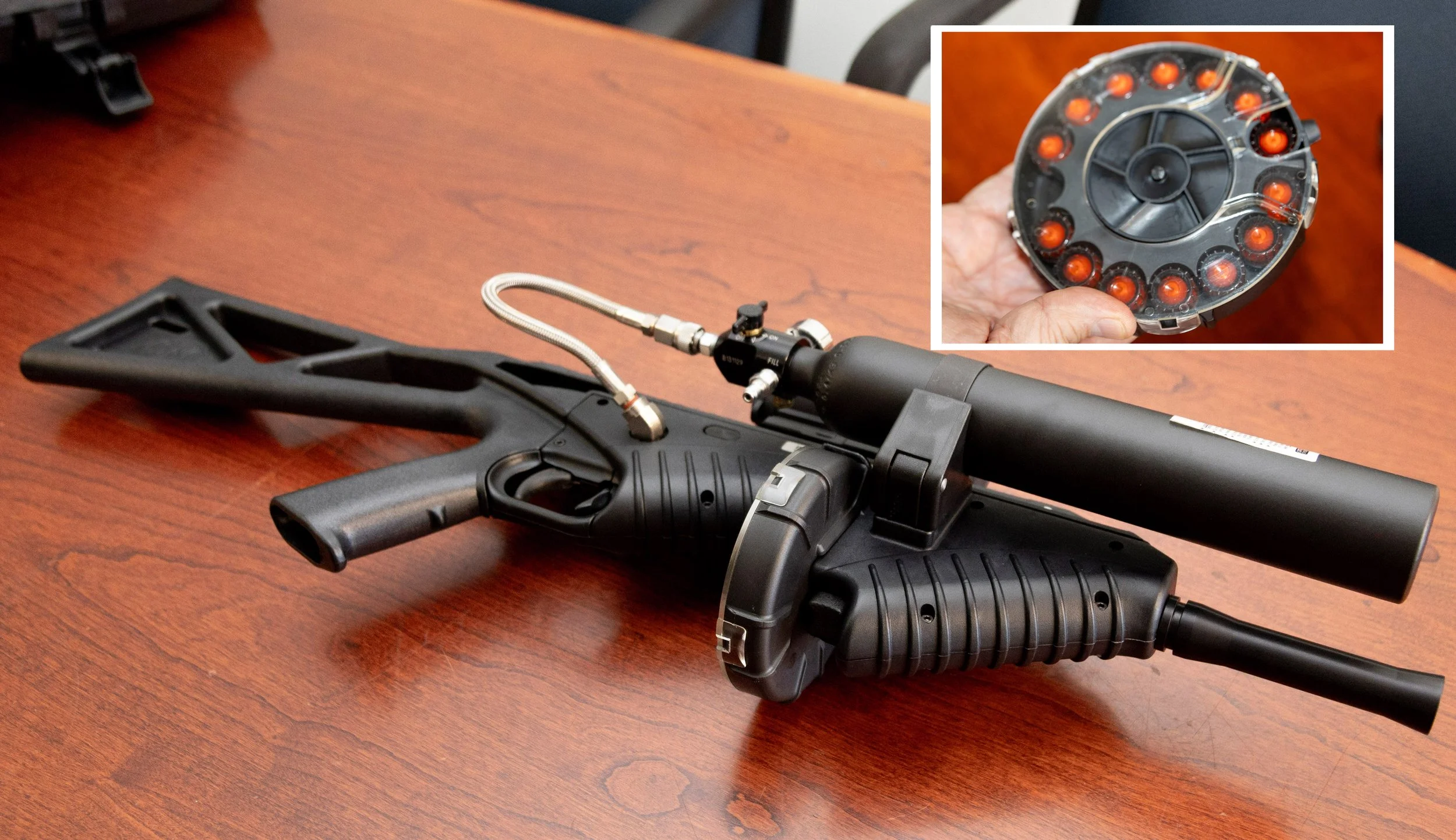
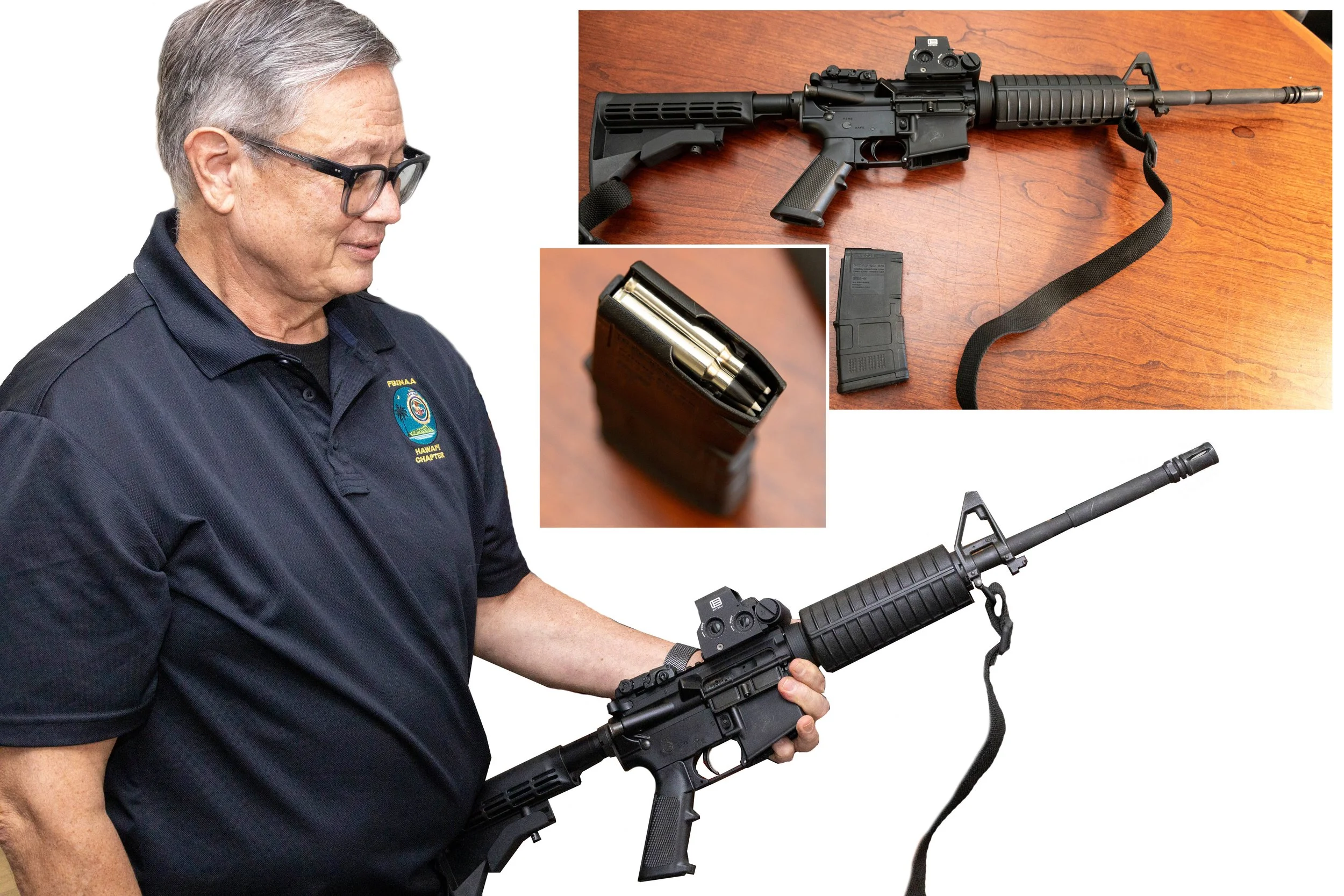
According to their 2026 annual military equipment report, SMCPD owns 10 Colt AR-15-style rifles with 12,600 rounds of .223 ammunition, 11,000 of which are earmarked for training. They also possess two FN Herstal 303 Launchers and 150 FN Herstal 303 PAVA/OC Powder Projectile Rounds.
The cost of obtaining this equipment is estimated at around $30,000, with the weapons needing to be replaced after 10 years. The .223 ammunition has a listed shelf life of two to three years. Santa Monica College Chief of Police Johnnie Adams said the FN 303 ammunition is all factory-purchased and does not consist of reloaded cartridges subject to stricter expiration guidelines.
Officers are required to pass a 16-hour AR-15 training course and requalify annually, firing 50 to 300 rounds of duty and/or practice ammunition rounds per qualification at an average cost of 90 cents per round.
Training requirements differ for the less-lethal munitions. “The qualification for the FN303 primarily deals with manipulation of the weapon and only five rounds are used per officer,” Adams said.
Although they are commonly referred to as less-lethal rounds, the projectiles fired out of the FN Herstal 303 Launchers have been responsible for at least one death.
In 2004, Victoria Snelgrove, a 21-year-old Emerson College student was struck in the eye by an FN 303 projectile, fired by a Boston police officer doing crowd control following a Boston Red Sox playoff game. She succumbed to her injuries 11 hours later.
On March 28, 2026, University of Southern California freshman Tucker Collins, 18, survived a similar eye injury that required doctors to remove his right eye.
Collins was working as a member of the press covering a No Kings protest when Department of Homeland Security agents fired indiscriminately into a crowd that included protestors and members of the press.
Former Corsair photo editor, SMC student and photojournalist Jake Crandall covered the protest the day Collins was injured and saw him being treated by medics. Crandall said several of his colleagues and friends have been severely injured by less-lethal projectiles and are still in the process of recovery.
“FN 303 holds 15 to 30 rounds, so they can just keep going and continuously spray into a crowd… which is pretty horrific,” Crandall said. “Because it is brittle and does break apart, the round will… if it's close enough range or soft enough skin, the round will break apart and leave fragments inside of flesh… I know protesters have had to have surgery to have them removed.”
The FN 303 launcher is semiautomatic and fires a variety of .68-caliber rounds that are roughly the size of a U.S. dime.
“If the rationale behind having these is that if there is a violent person on campus… I think that does make a lot of sense to have a weapon like that on campus. But, if the intended purpose of these is for a protest or crowd control… oftentimes it has the opposite effect of agitating the crowd more and making the crowd more violent,” Crandall said
Adams said the department has deployed the weapons once since purchasing them but didn’t fire them.
In 2025, SMC reported 20 total criminal incidents, 19 of which occurred on campus. Adams said most of the crime on campus relates to petty theft, such as stolen bicycles, and hate speech stickers being posted in bathrooms.
Adams has opted not to participate in the LESO/1033 Program, a federal initiative allowing the U.S. Department of Defense to transfer or sell excess or older military equipment to various law enforcement agencies. “From my experience, I noticed that the only equipment that comes out of that, that would be good would be their military vehicles, which there's no need for us to have a military vehicle,” Adams said.
Adams has extensive law enforcement experience. He was the 2019 president of the FBI National Academy Associates (FBINAA) and is the most recent recipient of the California College and University Police Chiefs’ Association Award of Distinction, in recognition of more than 40 years of dedicated service in university and college policing. He is a certified AR-15 instructor, an MP5 submachine gun instructor, and an instructor in shotgun, pistol, chemical weapons and tasers.
According to Adams, the rifles and protective equipment being sold through the 1033 Program are older stock that has been used or is outdated and unsafe by today’s standards.
Many law enforcement organizations have turned to drones to help with crime prevention and response. SMCPD does not currently own or operate any drones, which would also be regulated under Assembly Bill 481.
Budget constraints may make a drone program difficult for the department. According to Adams, startup costs for a drone program can be between $40,000 to $60,000, prior to training.
Federal law requires drone operators to be licensed by the Federal Aviation Administration by passing thePart 107 Remote Pilot Certificate Exam, which costs $175, while Assembly Bill 481 requires each use of the drone to be included in the college’s annual report.
Adams expressed confidence with his department's current equipment covered by Assembly Bill 481, but did not rule out a drone program in the future.
“Right now, we’re currently OK. Of course, you know, there are items like drones. The technology is moving forward, and I know some campuses have started to purchase drones, and that's something I may like to look at, at some point in time. But that’s down the line,” Adams said.