
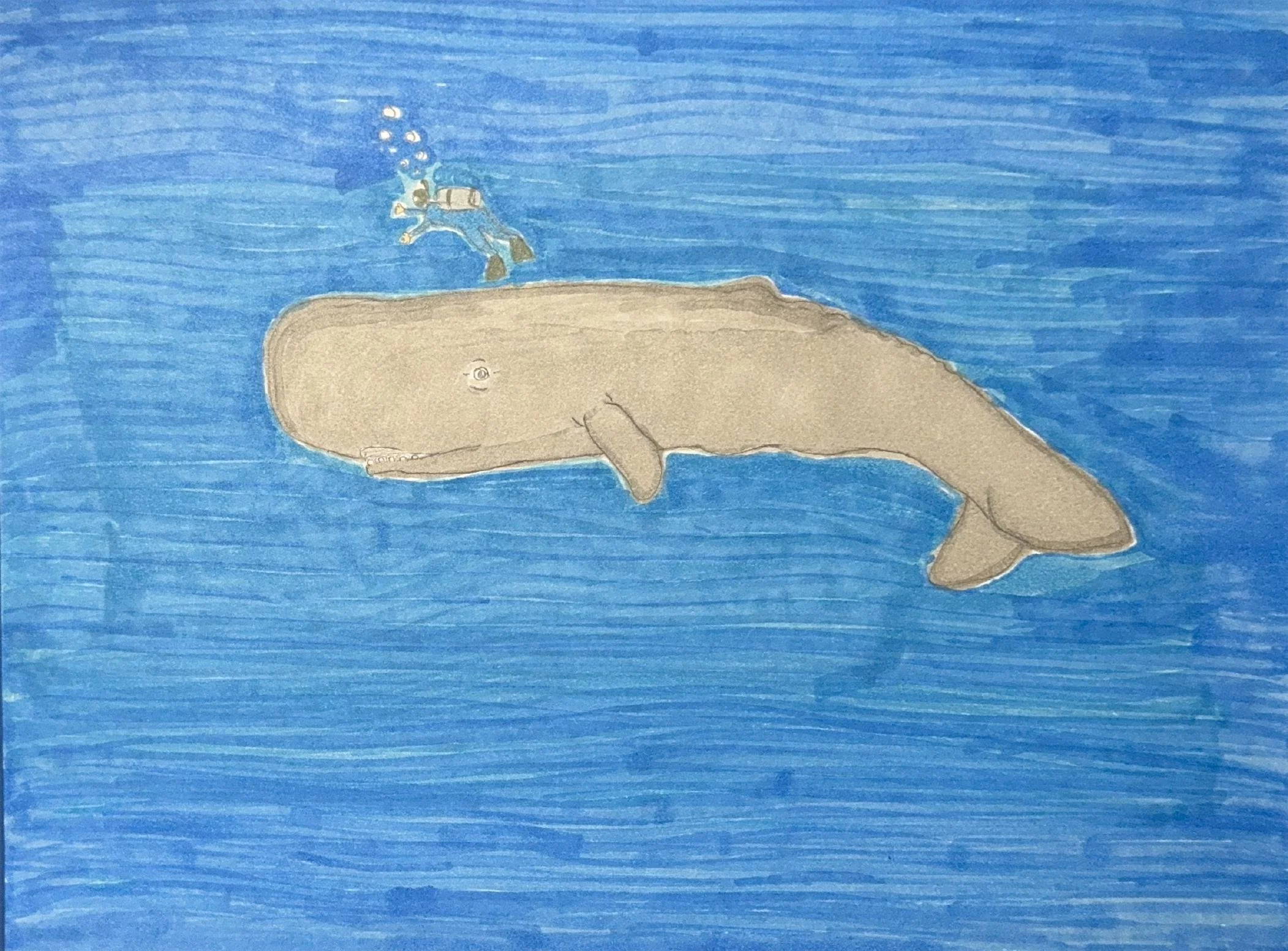
Whalefall, a novel written by Daniel Kraus, debuted as a film adaptation directed by Brian Duffield on Oct. 16. The film begins with protagonist Jay Gardiner, played by Austin Abrams wanting to search for the remains of his father in the ocean after he passed away. What begins as a search for his father quickly takes a wrong turn, leaving Jay to fight for his life with little to no oxygen.
In the beginning of the film, Jay’s father Mitt, played by Josh Brolin, always wanted to spend time together diving with Jay because he wanted to be close with his son again. As Jay grew older, he began to distance himself from his father. Jay, young and caught up in college life, rejected many of Mitt's attempts to connect, and rather spent his time with friends. Internally, Mitt struggled with the guilt of disappointing his son. Mitt felt as if his son would follow in his footsteps and repeat every single mistake he made in the past. It is revealed that his father was sick with mesothelioma, a form of cancer that attacks the mesothelium, otherwise known as the thin layer of tissue that covers a person’s internal organs. Jay’s mom would always tell him to spend time with his father because he didn’t have much time left and talked about Jay all the time. Jay’s sister would tell him, “You are what keeps him alive.”
Jay’s father commits suicide, overwhelmed with his health, not wanting to spend his final days in hospital beds with invasive and draining life-saving procedures. Mitt wanted to spend his last moments in the ocean, what he loved most. He tied weights to himself, jumped into the ocean, and sank to the bottom.
Jay, distraught and lost after his father’s death, drives to the beach one morning to search for his dad’s remains.
Lifeguards warned people not to enter the water because the tides were high, but Jay ignored them and went diving with gear and a tank that would last him about an hour.
The sperm whale just wanted to eat. It swam towards a large, dark red squid. In a panic, the squid attempted to escape the whale but its tentacles grasped Jay by his foot. The whale swallowed them both. Jay was stuck inside a sperm whale's mouth with a squid. It was intense as Jay tried to escape from both the squid and the whale. The soundtrack was the icing on the cake. As this was happening, tensions were high as people were either gasping, laughing, or even crying.
I found this movie experience deeply engaging because it was a thriller that had me grabbing onto my seat, yet so emotional it made me cry.
One of the most intense moments came when Jay was inside the whale with the squid that also wanted to eat him. The squid was able to bite his neck, but Jay was able to escape. It also bit and hooked onto his hand, which was very terrifying and painful to look at.
When Jay was trying to escape, he screamed from inside.“Help, I'm stuck in a whale,” he said. Then the audience started to laugh because he was screaming, but the lifeguards clearly couldn’t hear him.
When Jay tried to escape his third or fourth time, he stabbed the whale from within and caused the whale to scream, and dive deeper into the ocean. When it reached the pitch-black depths of the ocean, a pod of orcas surrounded the whale. As the sperm whale called for help, all the orcas ripped his short flippers apart. Then, all the other whales came to help and were able to fight them off, but it was already too late. Jay was still inside the whale when this was happening.
The family of whales brought Jay’s whale to the surface. Here, Jay ultimately makes his escape, using his airtank and batteries he had on his person to create a chemical reaction that explodes the whale. He escapes to the outside and is rescued by people on a boat. Jay’s sperm whale sinks to the bottom of the ocean.
This film was about more than Jay being stuck inside a whale. It was about how Jay had an absent relationship with his father and was trying to reach for that. Their relationship wasn’t a loving bond, and once his dad died, he wanted to find his remains to connect with his father. At the end of the film, it was clear to the audience that the whale represented Jay’s father. While inside, it was as if the whale was speaking to Jay through his father’s voice. While ultimately sad that the whale passed away, it provided closure to Jay, as though he had found his fathers remains.
Jay suffered injuries, flashbacks, and trauma—all throughout while being inside the whale. He remembered all the things his dad taught him about diving, which helped him survive. “You're what remains of me,” Mitt said. Eventually, Jay was able to feel connected to his father through the voices from the whale.
I was completely blown away by Austin’s Abrams acting throughout this film. It was incredible and made me feel all the emotions he felt. When he was inside the whale, he was having a panic attack and it showed in the expressions he was making, and it also made me feel claustrophobic seeing him in the tight space.
I enjoyed the cinematography all throughout the movie because it looked very realistic. From Jay being inside the whale’s stomach, to him being in its esophagus. It was fascinating how they created these sets for each scene and looked very detailed. The film had a relatively limited color scheme, making use of deep blues, turquoise, reds, and purples.
Despite the movie focusing on Jay inside the whale, Duffield made use of flashbacks that provided moments of Jay’s life with his father on the outside. As an audience, it was touching and really evoked sympathy for Jay’s circumstances.
Near the end of the film, Jay was still inside the whale, and was remembering a conversation he had with his dad about whales. His dad told Jay when a whale dies so many organisms come to life in the blink of an eye and “they call it Whalefall.”