
Civil rights leader Jesse Jackson's visit to SMC in 1988 and remembrance of his life.
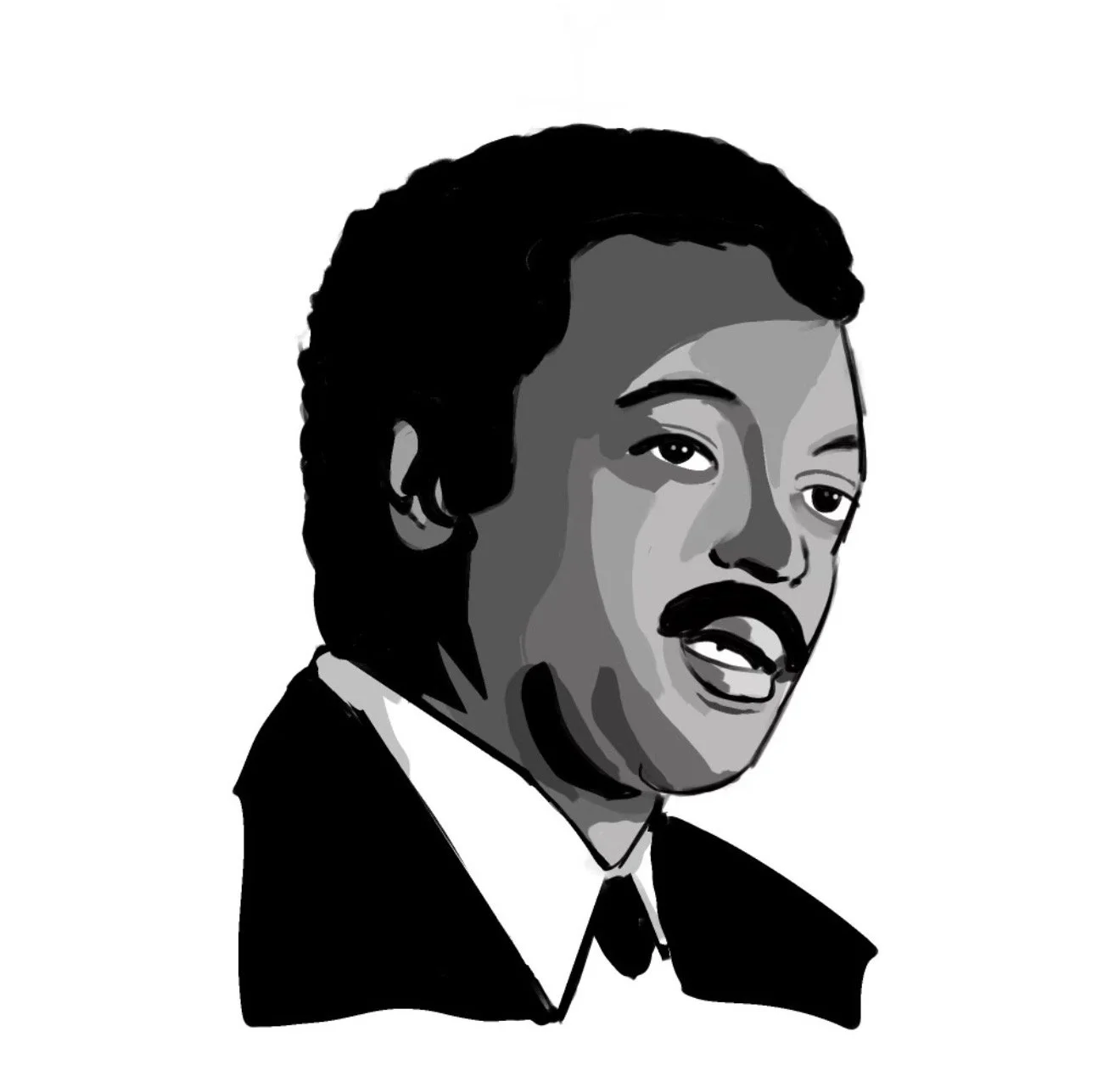
Illustration by Katie Easterson
Jesse Jackson, prominent civil rights leader and state senator, who passed away on Feb. 17, had a visit to Santa Monica College in 1988 to inaugurate a statue still on campus today.
Jesse Jackson’s life began in Greenville, South Carolina in 1941 during the Jim Crow era. As a top student in the late 1950s, he faced immense racism and segregation in his early schooling that continued into college.
Attending the University of Illinois for baseball and football, he eventually transferred to North Carolina A&T in Greensboro, North Carolina due to prevalent racism affecting his football career and public speaking activities at Illinois, Jackson told ESPN. Receiving his bachelor’s in Sociology from North Carolina A&T, he continued his education to focus on a master’s degree at Chicago Theological Seminary school but cut short of graduation due to the civil rights movement of the 1960s.
Working closely with Rev. Dr. Martin Luther King Jr. in the South through his work during the Selma Marches, King gave Jackson a high leadership position in his organization, the Southern Christian Leadership Conference, heading the Chicago branch.
In Chicago, Jackson led the now infamous Operation Breadbasket, which started in the Atlanta branch in 1966 and was a notable program encouraging African-American businesses and improving employment opportunities for African-Americans across the country.
Jackson also led the Black Expo in Chicago, a local trade and business fair bringing in speakers and businessmen from all over the country to help increase the political power of African-Americans in the government.
Jackson was present when King was assassinated in 1968.. Afterward, Abernathy led the SCLC, leading to leadership differences, as some of King’s peers believed Jackson should have led the SCLC, and Abernathy wanted to move Operation Breadbasket’s national headquarters from Chicago to Atlanta.
Differences between Abernathy led Jackson to leave the SCLC and form People United To Serve Humanity (P.U.S.H.) in 1971. P.U.S.H. organized boycotts of racist businesses and promoted Black political and economic power to invest and expand Black-owned businesses. By 1984 Jackson left P.U.S.H. to form the Rainbow Coalition to support his Democratic presidential campaign.
He won primaries in Louisiana, D.C., and South Carolina, defeating front-runner Walter Mondale, although Mondale later secured the Democratic nomination at the 1984 convention.
Losing the Democratic candidacy to Mondale and ultimately the race to Ronald Reagan, Jackson spent his next few years campaigning for youth efforts in schools in New York, anti-drug positions and community support in Kansas City, as well as meeting with local elected officials in Chicago.
Come 1988, Jackson ran a stronger presidential campaign, gaining support by having strong stances on Reagan era policies. He won Democratic primaries in Puerto Rico, Alaska, South Carolina, and Michigan Democratic, but came in second to Michael Dukakis, who secured the nomination. Dukakis was a standalone candidate at the 1988 DNC, and without Jackson on the ballot for Vice President, he lost to George H. W. Bush.
During Jackson’s race for the Democratic primary, he visited college campuses across California, including Santa Monica College. During his visit he criticized Reagan’s policies that “enrich big businesses and the upper class at the expense of the rest of the country” and raised issues regarding health insurance and affordable housing in California affected by ‘Reaganomics’.
Shortly after his rally ended, he passed by a recently built sculpture, “Abstract Ruins III”, created by artist and architect David Hertz, a seating arrangement in the free-speach area under the Carob Tree near the Organic Garden on the main campus, formerly an outdoor amphitheater.
Hertz, who was present during the inauguration of the sculpture and the creation of it, spoke to the Corsair about its importance. “(Abtract) Ruins suggests time, resilience, memory, and the layered history of human presence. Rather than replicating historic forms, I abstracted those ideas into a contemporary sculptural language. In the 1980s there were still concerns about the potential of nuclear extinction so I was interested in creating forms and materials that would survive and provide remnants for future generations.”
On the importance of “Abstract Ruins III”, Hertz mentions how Jackson was invited to campus directly to inaugurate the sculpture, using it as Hertz describes, “a symbolic soapbox — an architectural gesture toward free expression.”
During the inauguration Jackson was also joined by former campus Arts Director Keith Quaintance who urged Jackson to lead a chant with the crowd. “Keep hope alive- Give peace a chance. Up with hope-Down with dope. Peace in the Middle East, freedom in South Africa. We the people will win June 7th, Jackson Action.”
In 2021, Hertz and former art history director, and current art department chair, Walter Meyer led a five-day project to restore the sculpture before the 2021 fall semester. Hertz said it was restored with “careful structural assessment, material repair, stabilization, and in some cases selective reconstruction.” He said, “The goal was to preserve its integrity and continuity,” and that Jackson’s speech “brought the themes of expression, voice, and civic participation into direct alignment with the conceptual intent of the work.”
After multiple campaigns following 1988, Jackson became a shadow senator for the District of Columbia (non-voting positions in the Senate to rally for statehood, with DC and Puerto Rico the only places to have such) which was one of his most notable political offices.
The following decades saw Jackson rallying for Al Gore in the 2000 DNC and Barack Obama in 2008. He led peace delegations in Afghanistan following the 9/11 attacks with the Taliban, supported labor strikes, and called for arrests and justice for the murders of Trayvon Martin, Michael Brown, Breonna Taylor, and more recently George Floyd.
Jackson passed away on Feb. 17, 2026 in Chicago at age 84, surrounded by loved ones. A vitally important figure not just to American politics but to civil rights, LGBTQ+ rights — being one of the first to mention such issues in a speech — labor rights for farmers and union workers, and advocacy for the every-day man.