
Living Without Cars
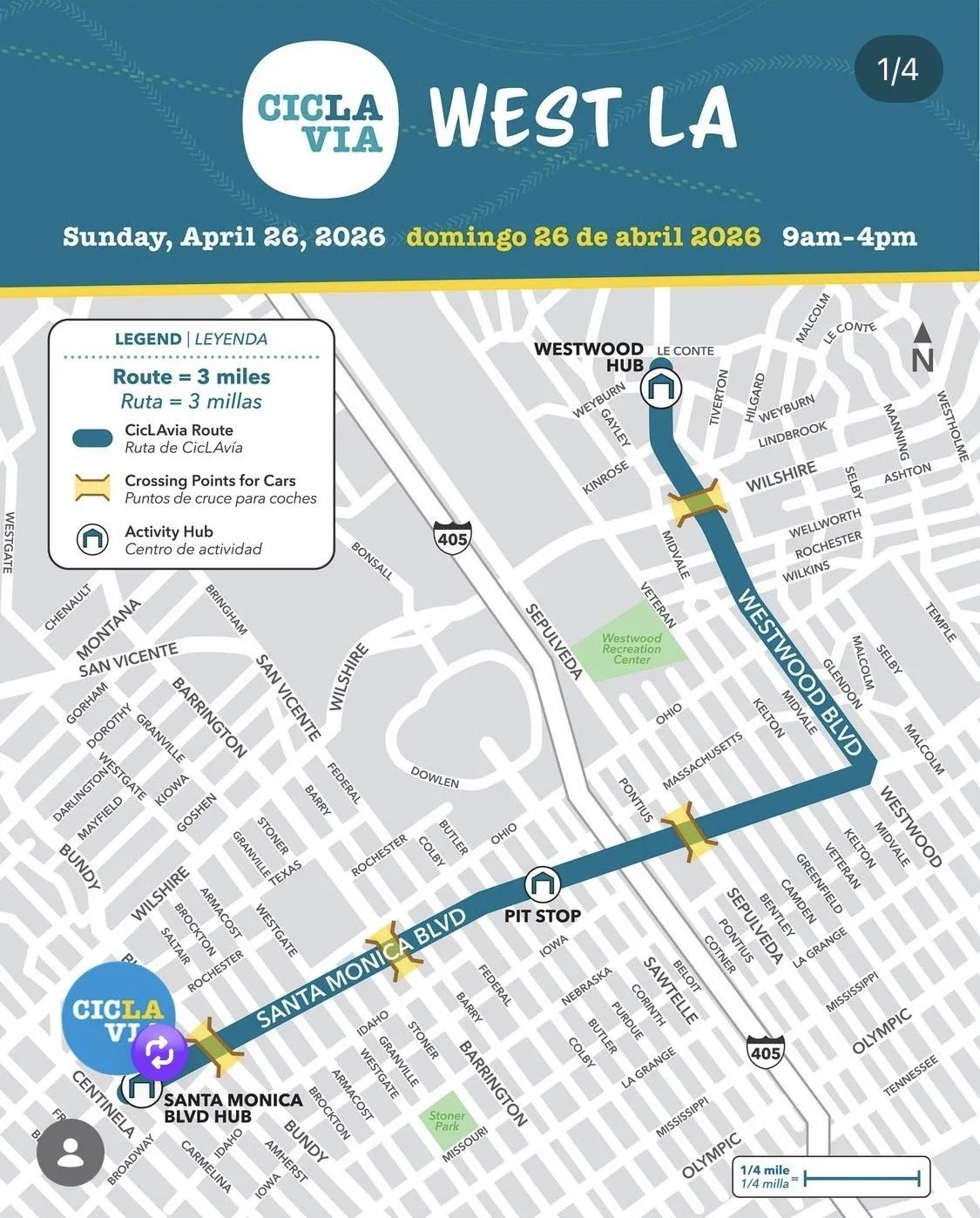
A car-free day is coming to Los Angeles this Sunday, April 26 as CicLAvia shuts down portions of Santa Monica Boulevard and Westwood near the 405, opening the streets to pedestrians and cyclists, completely car-free.
The event, part of the non-profit “open streets” movement, invites residents to experience LA without vehicles.
For many Santa Monica College students and Los Angeles residents, that experience is already part of daily life.
Connor Hundertmark, an SMC student, said he relies on a mix of biking and public transit to get around, though he draws boundaries between the two.
“I don’t take the bike to school. I only take it to work,” Hundertmark said. “To work I feel like I have to remain in control of my bike and watch out for others at all times otherwise I will die.”
For school, he commutes from Koreatown and opts for the bus, describing his routine as simple. “I just take the 207 down to Wilshire and Western and then I take the Blue Bus seven to school,” he said.
Hundertmark added that SMC’s GoPass is a factor to avoid car ownership. “It’s way cheaper,” he said, noting he prefers to invest his money rather than spend it on a vehicle.
Still, he acknowledged the reality of transportation. “I think LA is a car city,” he said. “I think there’s very few American cities that aren’t.”
That perception is part of what CicLAvia aims to challenge.
Caro Vilain, an SMC alum who lives car-free, said the event demonstrates what is possible when streets are designed for more than vehicles.
“There’s nothing like showing people that a better world is possible, and CicLAvia does that incredibly well,” Vilain said.
Vilain pointed to Los Angeles’ climate, growing metro network, bicycle infrastructure and dense neighborhoods as advantages for alternative transportation, noting that many trips are relatively short and could be made without a car. However, she said there are still barriers that hinder people from making the change to go car-free.
“CicLAvia is an amazing way to introduce people to riding bikes on a city street,” she said. “But in order to get people to use these modes consistently, they need to feel confident they can do so safely.”
An SMC 2024 transportation survey of 646 students shows that concern. Just under half of students said they either strongly agreed (13.4%) or agreed (22.9%) that they feel safe biking to and from campus, suggesting that safety remains a key factor in transportation choices.
For some advocates, events like CicLAvia are as much about community as mobility.
Kerry Beth Kaufman, a Long Beach resident and organizer with several bike advocacy groups, said car-free streets can help us reconnect.
“Events like CicLAvia that transverse multiple neighborhoods bring connectivity back by giving streets back to the people,” Kaufman said.
She described a quiet shift when cars are removed, free from “road-noise” granting people to interact more easily.
“It allows people to slow down and take their time,” she said. “They see the faces of their neighbors and their communities without the obstruction you get when we’re all in metal cages.”
Rising gas prices may also be prompting more residents to reconsider how they travel. Kaufman said higher costs can serve as a catalyst, though not a complete solution.
“Price alone will not eliminate LA’s car-centric culture,” she said. “But this time is an opportunity to try out alternatives.”
Joshua Sommers, a Koreatown resident who does not own a car, said the event allows us to rethink options that are often overlooked.
“Events like CicLAvia are important because they highlight how accessible and tangible so much of LA is if we think about cars as just one method of transportation instead of the only feasible way,” Sommers said.
He added that transforming streets into public spaces can also benefit local businesses and strengthen community ties.
“When a street transitions from a conveyance for cars to a public amenity it promotes community and commerce,” he said.
Despite differing perspectives, whether that shift leads to lasting changes in the way we commute remains uncertain. For now, the event provides a space for residents to grab a bicycle and imagine what Los Angeles could look like without cars.