
“Minnesota nice,” but not to ICE: A mirror reflection of L.A.

Minnesotans will feed you if you’re hungry, and take offense if you deny their generosity. They’ll give you clothes off their backs to ensure you’re warm in hair-freezing, frostbite-causing, record cold temperatures. So when immigration agents rolled into the Twin Cities, people marched on frozen streets with signs held high, reading, “Minnesota nice, but not to ICE.”
Resisting tyranny isn’t new to Minnesota. Many of its early governors were Union soldiers, and it was the first state to take up arms for America in the Civil War. To this day, the Minnesota Historical Society still possesses the 28th Virginia battle flag, and they refuse to give it back. “Why? I mean, we won… We took it, that makes it our heritage,” said former Gov. Jesse Ventura in 2000 after denying another request for the trophy to be returned.
Angelenos and Minnesotans share many similarities. Those include a hatred of Immigration and Customs Enforcement, and a love of a good fight. When the Department of Homeland Security started Operation Metro Surge, an immigration crackdown, in the Twin Cities, residents used a few tactics I’ve seen in Los Angeles and raised hell with a good amount of mutual aid in between.
I flew to Minnesota on Jan. 28 with an ungodly amount of credit card debt, clothes fit for a Siberian winter and the protective gear required in a war zone.
A gas mask is necessary — in my experience, sometimes just standing near a fence pointing a camera is enough to incur a DHS agent’s wrath — but armored plates seemed excessive. Until law enforcement gunned down two U.S. citizens.
Jonathan Ross, an ICE officer, fatally shot 37-year-old Renée Nicole Good on Portland Avenue near East 34th Street in Minneapolis on Jan. 7, after she tried driving away as authorities pulled her door handle, trying to get into her vehicle. After shooting her, he muttered “fucking bitch” towards her dying body and walked away.
Alex Pretti, an intensive care unit nurse who worked at the Department of Veterans Affairs hospital, confronted a Customs and Border Protection agent for pushing a woman on Nicollet Avenue near East 26th Street on Jan. 24, and it cost him his life. CPB pepper-sprayed, beat and subdued Pretti; then two federal agents — identified as Jesus Ocha and Raymundo Gutierrez by ProPublica — shot him.
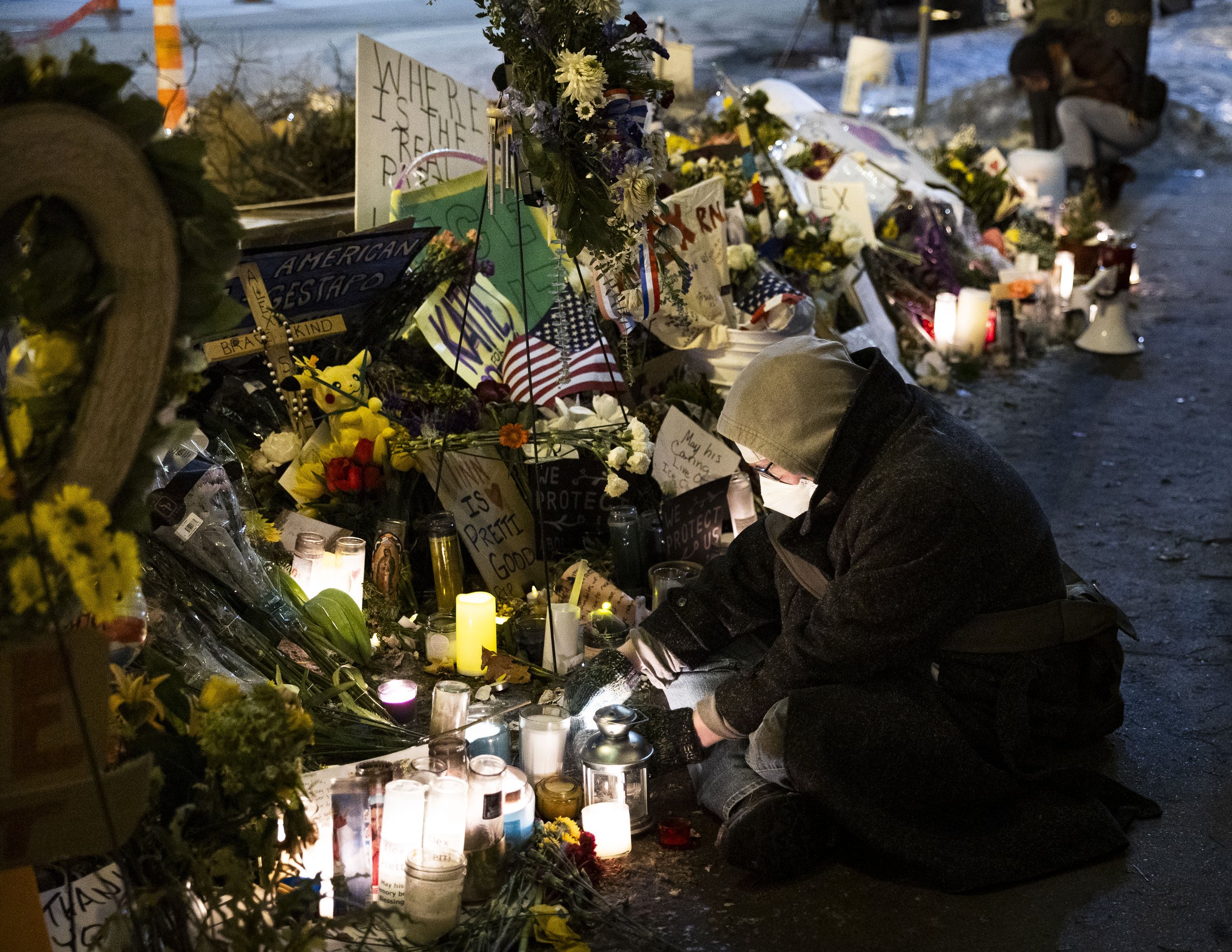
“It’s a lot of overreach. There’s — I mean, it’s a list at this point,” said Tomas Hunter, a U.S. Navy veteran at the Pretti memorial on the street where he died. “It’s like the first, second, fourth, tenth amendment. I mean, on a regular basis, these guys are trampling on, you know, what we swore an oath to.”
I went to Pretti’s memorial before picking up my colleagues from the airport; I needed a moment alone to process the images ingrained in my mind of the state violence committed in Minnesota. I’ve seen the Los Angeles Police Department attack and leave people as dying, bloody pulps — beaten within inches of their lives — but at least they have the dignity to do it without a mask.
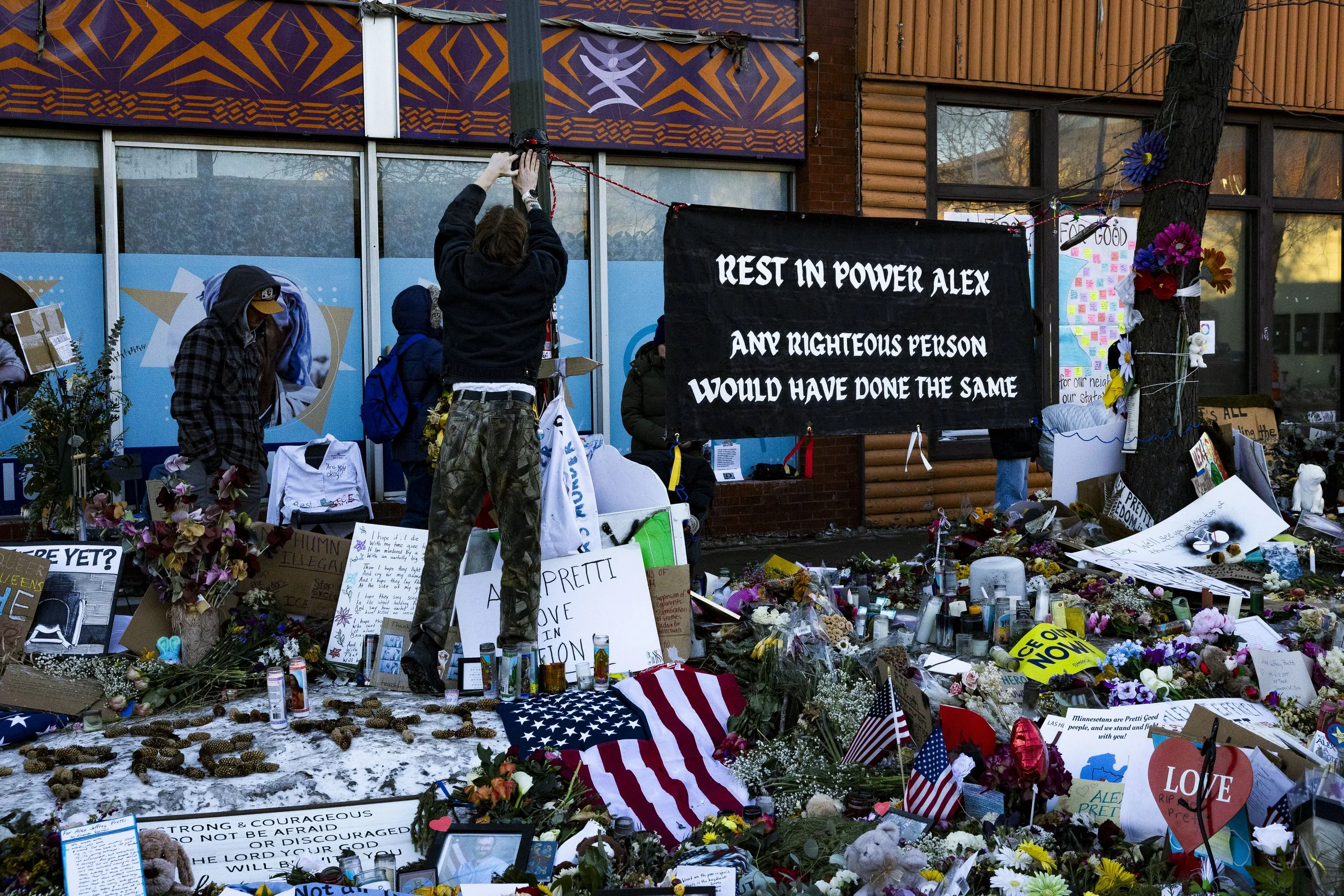
At Pretti’s memorial, there’s a black banner strung between a tree and a lamp post that states, “Rest In Power Alex Any Righteous Person Would Have Done The Same.” Underneath, the pavement is covered in vases with multicolored flowers, posters that read “Justice For Alex,” and white half-burned candles.
The crowd size at Pretti’s memorial fluctuates, but someone’s always there, standing underneath a solemn cloud that hangs over the site, offering handwarmers, food and company. Many people cried while praying over candles at the site, and some just wore thousand-yard stares, looking at the ground in disbelief.
I wanted to conduct interviews, but my knees felt weak, and I appeared to be a shivering, cold, anxious wreck; so I left to collect myself and find some sleeping aids.
A Los Angeles Hello in Minnesota
Slowly waddling through the crisp, skin-burning Minnesota breeze to a dispensary, I noticed how much Minnesotans hate masked federal agents seizing people in their neighborhoods. Almost every storefront has a red and white rectangle sign depicting a snowplow pushing law enforcement that states “I.C.E OUT OF MINNEAPOLIS,” and if you mistakenly stare at someone long enough, you’ll be questioned if you’re an officer.
The budtender, a tall woman with bronze skin and curly, thick hair taught me this after a tense exchange at the dispensary. After some light-hearted chit-chat, she marked me as an out-of-towner and suddenly dropped her customer service voice.
With her hands of steel clenched and ready to rumble, the budtender straightened her back and, with her whole chest, said, “That’s cool, where you from?”
Stunned, flabbergasted even. Five words transported me back to LA, and I didn’t know whether to be alarmed or insulted that she’d assume I was law enforcement.
I started stuttering and bumbling my words, but eventually I was able to string together, “Me? Oh, I’m a journalist from LA here to cover — well, everything.”
For a second, we stared at each other with heavyweight championship bout animosity, locked in and facing down. Whoever blinks first loses.
The budtender unclenched her hands, relaxed her back and as if she didn’t just terrorize me, said, “Phew, that’s a relief. I thought you were ICE.”
“No,” I said, skin turning pale blue. “I was fit enough for the Navy at 17, and now I do this.”
She laughed and raised a hand to her mouth to hide her smile. “Here, take these,” she said, tossing me a bag of gummies with a smile slowly growing across her face. “You don’t need to pay. You’re doing the Lord’s work.”
I thanked her and skedaddled to pick up my colleagues.
Life in a Post-Modern Time
On Jan. 29, I started my day at a cafe, Modern Times, that switched to a donations-only model for the duration of Operation Metro Surge. “Until this occupation is over, we are Post Modern Times,” the owner, Dylan Alverson, wrote on Instagram. “Post Modern Times is free for all with the exception of our occupiers!”
At this newly-christened finger in the face of capitalism and government reliance, people waited bundled up inside for their name to be called from the 30-minute wait list, but few seemed to mind. I stepped outside for my morning cigarette, and down the street I saw another form of Minnesota resistance.
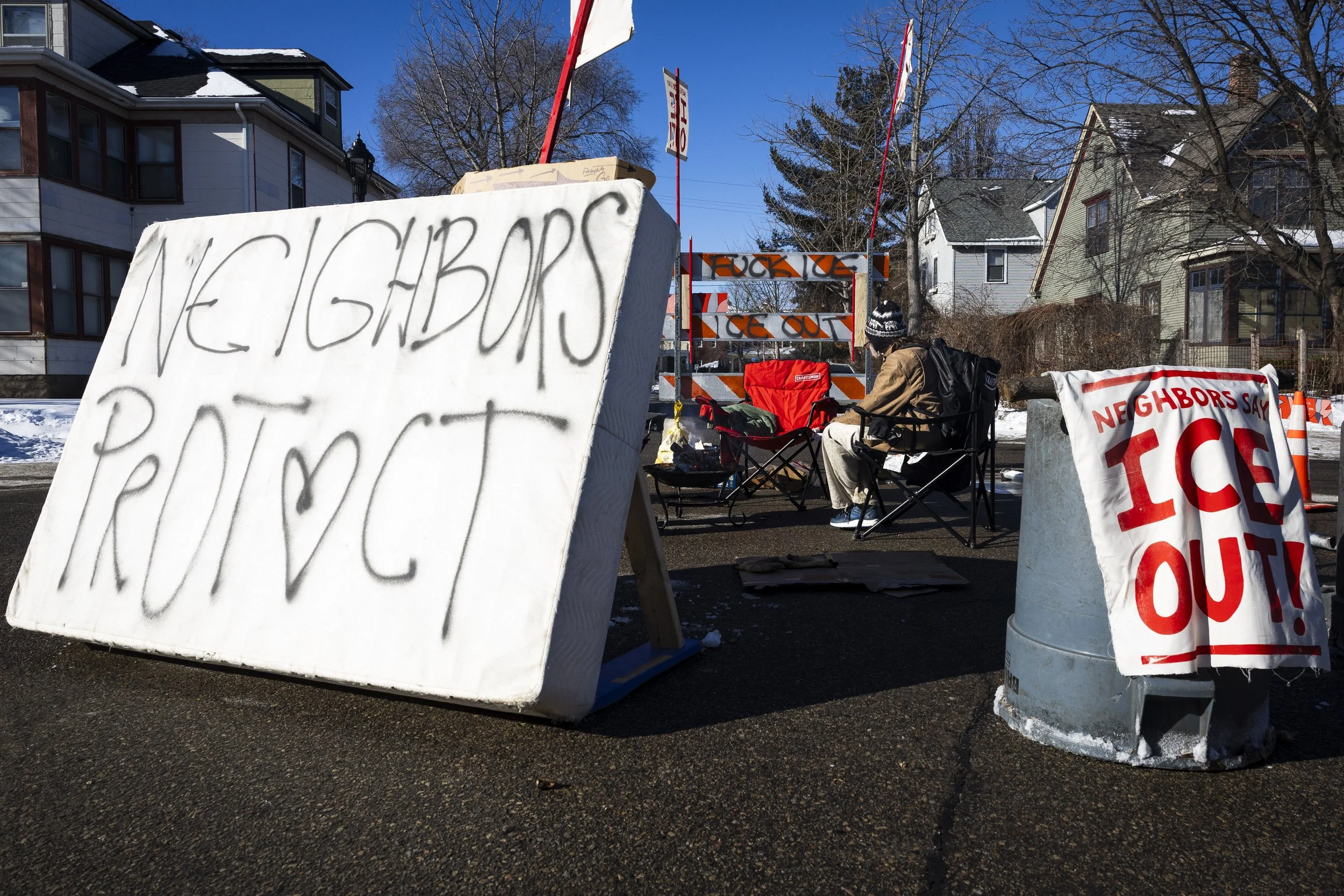
Huddled around a blazing campfire on the intersection of East 32nd Street and Columbus Avenue, community patrollers sat in a makeshift circular post constructed of traffic barricades, flipped trash cans with white banners that say “Neighbors Say ICE Out!” and an old beat-up mattress with “Protect Neighbors” spray-painted on the back.
Minnesotan community patrollers, like in Los Angeles, canvas their neighborhood for law enforcement, but they’ve also arranged posts in gridded neighborhood intersections and roadblocks on main streets, looking for and reporting ICE vehicles to encrypted Signal chats and StopIce.net.
“They (ICE) seem scared,” said Rosie Averrit, a community patroller checking license plates at a roadblock on East 32nd Street and Cedar Avenue. “When they see us, they try to turn around. They try to drive off really quick, and I think all of these little disruptions from many different people in all different directions are going to be what continue to push ICE out of Minneapolis.”
Minnesota needs ICE out of the Twin Cities; Operation Metro Surge is strangling the economy blue. At least 30 of the 35 businesses at Mercado Central on East Lake Street in Minneapolis are shuttered. It's an abandoned ghost town with a few lonely store owners sitting and resting their heads on their storefront gates, emptily staring down once-lively passageways.
I asked an elderly Mexican woman selling lion-printed blankets what happened, and through her exhausted, silent stare, she said in Spanish, “You already know, son.”
A Lie Sparks Mass Resistance
Immigrants are like engineers on a U.S. Navy war vessel: a wildly underappreciated hardworking bunch that’s keeping the stinking thing afloat. According to a 2026 study from the libertarian think tank Cato Institute, from 1994 to 2023, migrants generated more in taxes than they received in benefits — across all levels of government — and contributed a cumulative fiscal surplus of $14.5 trillion to the economy, possibly preventing a fiscal crisis.
Twenty-three-year-old YouTuber Nick Shirley is at the center of the whole Minnesota debacle. In December 2025, he set forth to prove that Somali immigrants were committing widespread fraud by barging into daycares, demanding to see children.
Shirley’s video went viral. President Donald Trump, Vice President JD Vance and tech-billionaire Elon Musk all re-shared the reporting, and it garnered millions of views on social media.
According to a CBS News investigation, two of the daycares featured in Shirley’s video had been shut down earlier in 2025, and all active daycares he mentioned had licenses, with state regulator visits done within the last six months.
Still, it was enough to convince the Trump administration that Minnesota needed a visit from DHS.
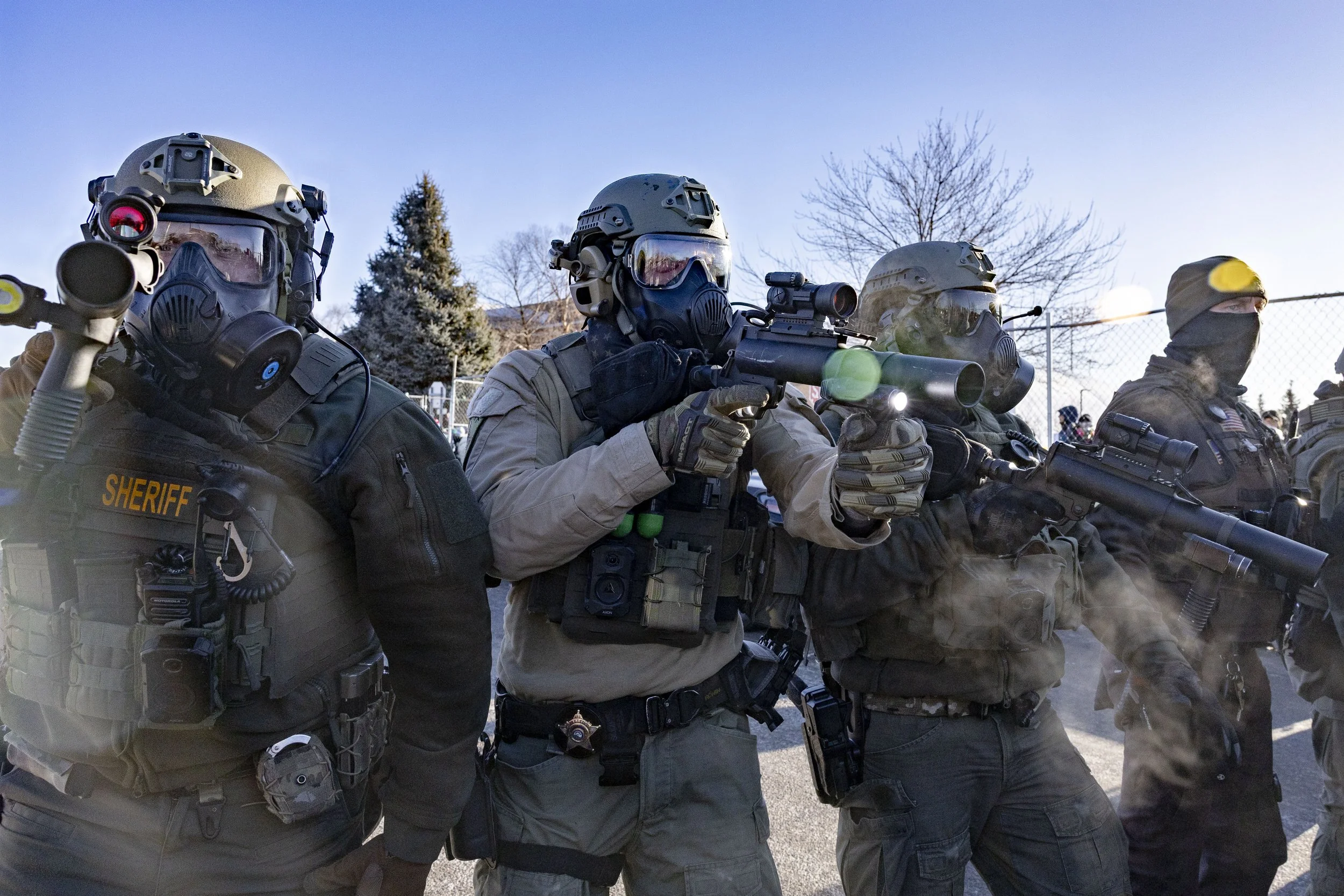
At an ICE staging location outside the Bishop Henry Whipple Federal Building in Minnesota on Jan. 30, I witnessed an old man with a brown wooden cane and a vintage rubber gas mask shout, “They can’t kill us all,” as Hennepin County Sheriffs pushed protesters back.
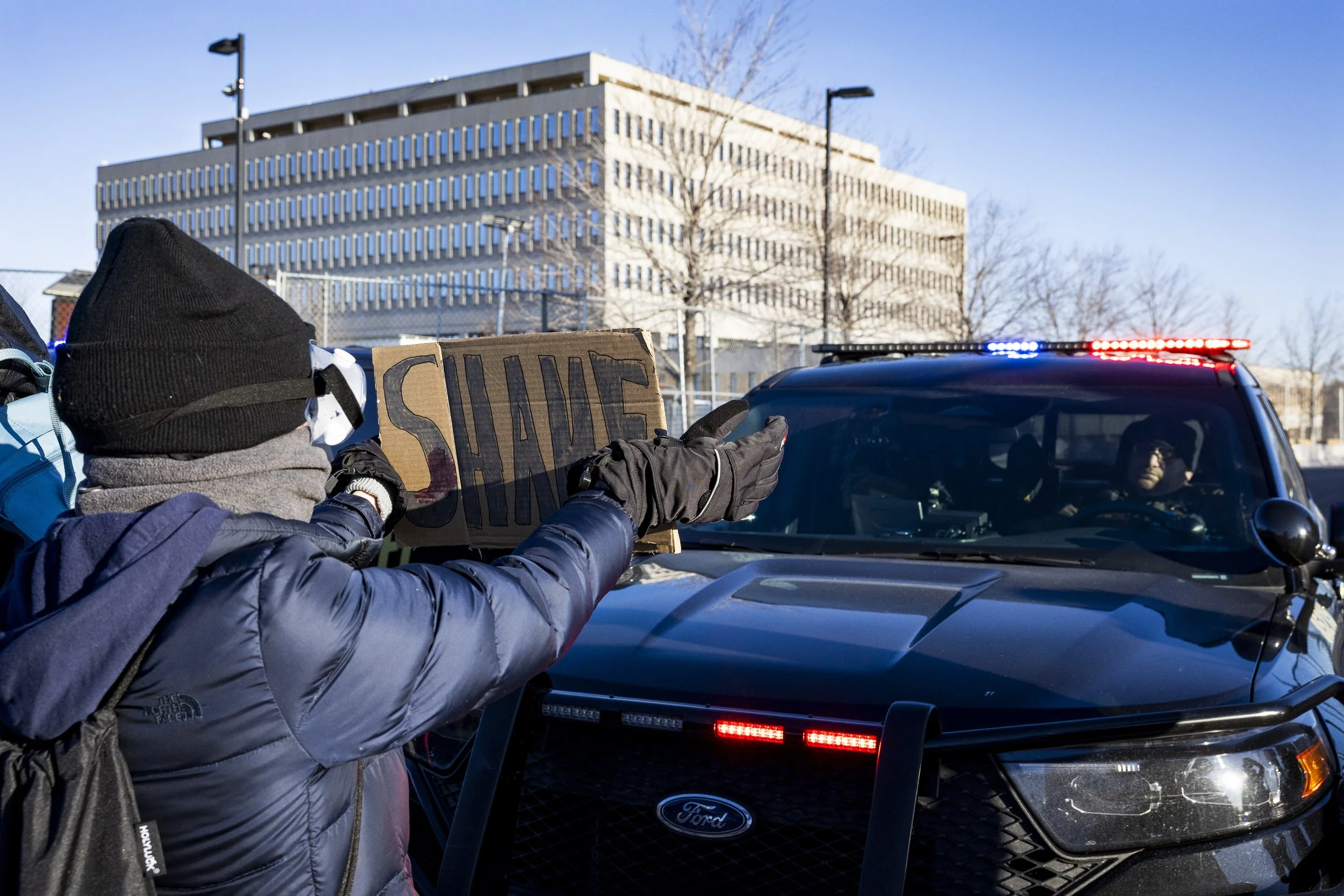
Protesters have clashed with authorities outside the federal building multiple times since Jan. 8, the day after Good was killed. Ironically, Whipple was an Episcopal priest and an indigenous rights advocate who stood against forced separation and violence forced upon native people in the 1800s, said Kelly Sherman-Conroy, a pastor at All Nations Church in Minneapolis and a theologian at St. Olaf College.
“What he stood for, and what it is now, is everything that he fought so hard against,” she said. “That’s important to understand, that history of the Whipple building, because he fought for people’s rights.”
My NB-100 tactical gas mask with a 40-millimeter N-B-1 defense filter fogged up as soon as authorities started waving around kinetic projectiles and pushing the crowd. I couldn’t see, but heard chaos and smelled panic — that’s the direction my camera needs to be.
Approximately 100 people stood outside the federal building that Friday, a seemingly manageable number for law enforcement. But at 2 p.m., an angry giant stormed through downtown Minneapolis shaking windows while shouting, “El pueblo unido jamás será vencido.”
Students Wake a Sleeping Beast
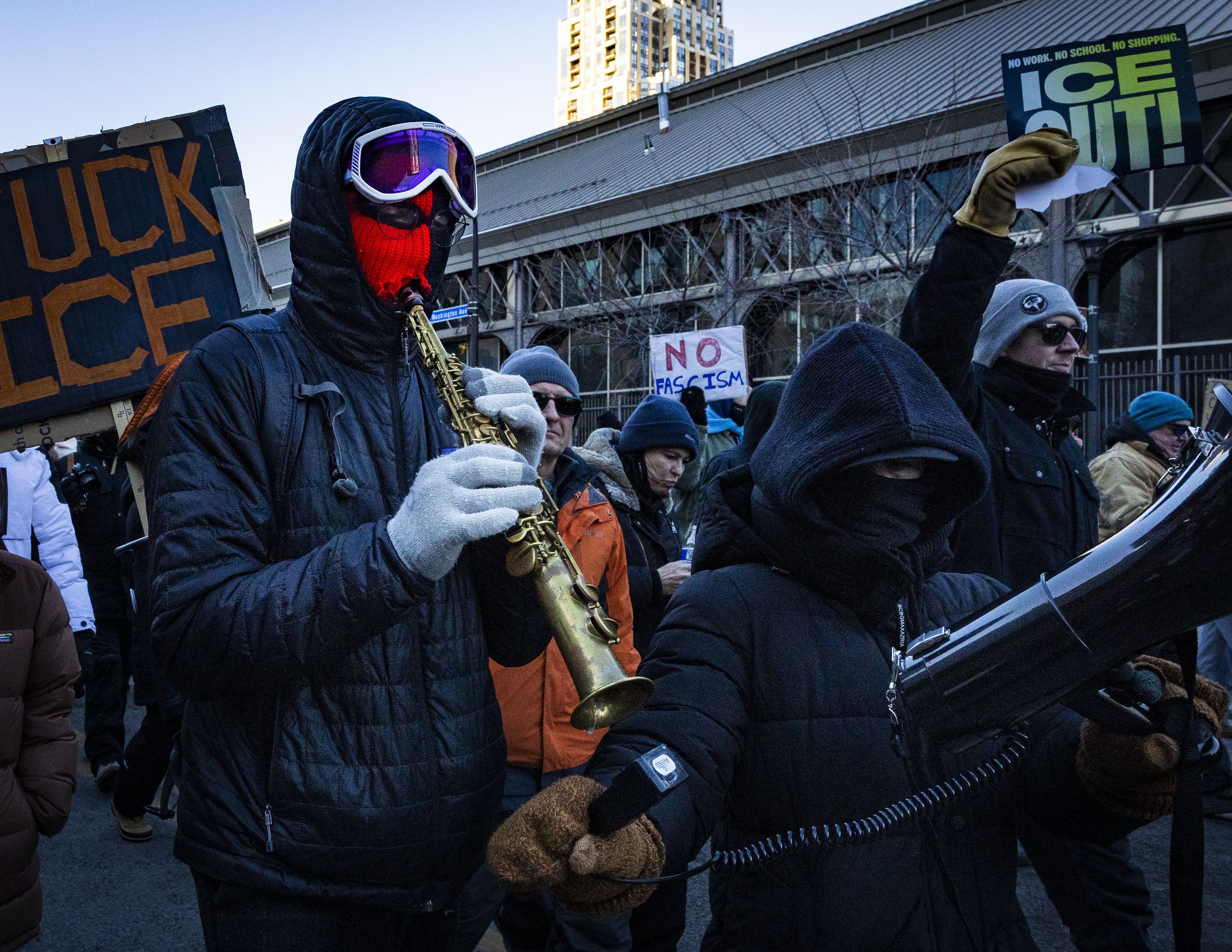
Black and African student organizers at the University of Minnesota called for a nationwide general strike and march in downtown Minneapolis on Jan. 30 to protest ICE. Tens of thousands of people from across the nation rallied.
Demonstrators marched from the Hennepin County Government Center near South 5th Street down to Commons Park on Portland Avenue in unfortunate weather. Sweat frosted my hair, Mother Nature’s cold touch turned my phone off and I slipped on black ice multiple times while searching for the end of the line.
Trinity Ray, a traveler from Iowa, stood atop a grassy knob watching people dance at the end of the demonstration. “I’m blown away; it’s so cold, and I was watching the line come down the road, and it just kept coming and coming. I think I stood in one place for close to an hour watching people come,” he said.
To help with the shakes, an Argentine restaurant called Boludo on South 4th Street in Minneapolis offered free coffee during the strike. After coffee, freelance journalist Sean Beckner-Carmitchel insisted I meet Tracy Wong, “an angel,” he said.
Wong owns the Vietnamese restaurant My Huong Kitchen on Nicollet Avenue near Pretti’s memorial. On Jan. 24, Wong opened her doors to people who were doused with tear gas and pepper-spray by law enforcement while protesting Pretti’s homicide.
Beckner-Carmitchel ran into My Huong Kitchen after law enforcement drenched him in mace. Wong sheltered him and provided spring rolls and “the best Vietnamese coffee I’ve ever had” — on the house. Protesters also gave him water and wiped the “absolute covering” of chemical irritant he received off his black jacket and camera, he said.
After hearing about Wong, I needed to meet her: not just for the delicious free chicken soup she handed out on Jan. 30 during the strike, but also to thank her for helping my friend. At the restaurant, Beckner-Carmitchel tried to express his gratitude to her alongside me, but every time he started a conversation, someone would enter and sing their praises.
The Giving Nature of Minnesota Nice
Generosity is commonplace in Minnesota, especially within the Somali community. I learned this on Jan. 31 from a kind-hearted gentleman at Hufan Restaurant & Cafe on East Lake Street in Minneapolis.
I needed food to prepare for a day filled with protests. Beckner-Carmitchel recommended the restaurant, claiming that if I left Minnesota without trying Somali tea, it would be a crime.
In line, I wore a puzzled look, trying to find something my childish taste buds would like. Standing there for what seemed like an eternity, a few people in the restaurant noticed my bewildered stare and started offering help.
“You should try the goat liver,” said a man seated at a table next to the ordering line.
“Great,” I thought. “The one thing in the world I hoped he wouldn’t recommend.”
I turned to him, trying to hide my sourface and said, “How’s the chicken suqaar?”
Another man standing in line burst out laughing and said, “Is it your first time trying Somali food?”
I simply nodded and said, “Yes, I’m a bit uncultured.”
With a giant smile, he turned to the young cashier and said, “Wonderful. Give them anything they want, I’m paying.”
My entire friend group became wide-eyed and started telling him we couldn’t accept his offer, but with a wave of his hand, he put the argument to bed.
“Please,” he said, raising his hand to his chest. “You’ll insult me if you don’t. It’s Somali culture.”
My head hung low, but I smiled through the guilt and accepted. I turned to the cashier and a customer sitting at a table, who only nodded and said, “It's true.”
I was in awe at their kindness, but it didn’t end there. Around 11 a.m., at a Minnesota Immigrant Rights Action Committee protest at Bryant Square Park on South Bryant Avenue in Minneapolis where demonstrators demanded an eviction moratorium, a Somali man volunteering as a road guard saw me struggling against the unforgiving chilly wind and gave me his winter gloves.
After our initial encounter at the beginning of the march, which ended at Pretti’s memorial, the man would constantly stop me and ask if I needed something. Over the course of the walk, all he did was help strangers.
A Target on the Back of a Billion-Dollar Company
Following the protest at Bryant Square Park, I raced over to a Twin Cities Democratic Socialists of America anti-ICE demonstration in front of a Target on Southeast 5th Street and 14th Avenue.
The DSA arranged a boycott and multiple sit-ins of the retail company, which is headquartered in Minneapolis, on Jan. 31.
“(Target) said a bunch of performative things, but they’ve let their workers be tackled and violently detained by ICE. They have not told ICE to not stage on their properties, and so we’re here to tell Target that we demand more of them,” said Brooke Bartholomew, co-chair of Twin Cities DSA.
Target shuttered its doors before the demonstration, but the small and mighty group of approximately 20 people picketed out front anyway, marching in circles, shouting the streets were theirs.
I reached out to Target to verify the claim that ICE is staging on their properties, but as of publication, they have not responded.
No Party Like an L.A. Party
I didn’t stay long at Target. While there, a source told me about an anti-ICE noise demonstration at the Hampton Inn & Suites Rogers in Rogers, Minnesota, at 9 p.m., and I needed to charge my batteries.
Noise demonstrators rally outside hotels that reportedly house ICE agents and attempt to keep them awake all night by creating symphonies of clamor. In Los Angeles, I have witnessed masked percussionists bang metal pots on city trash cans, brass sections blowing vuvuzelas with FIFA World Cup ferocity and cellists carving strange sounds out of an amp by scratching a guitar chord on its face, all while yelling until they’re hoarse.
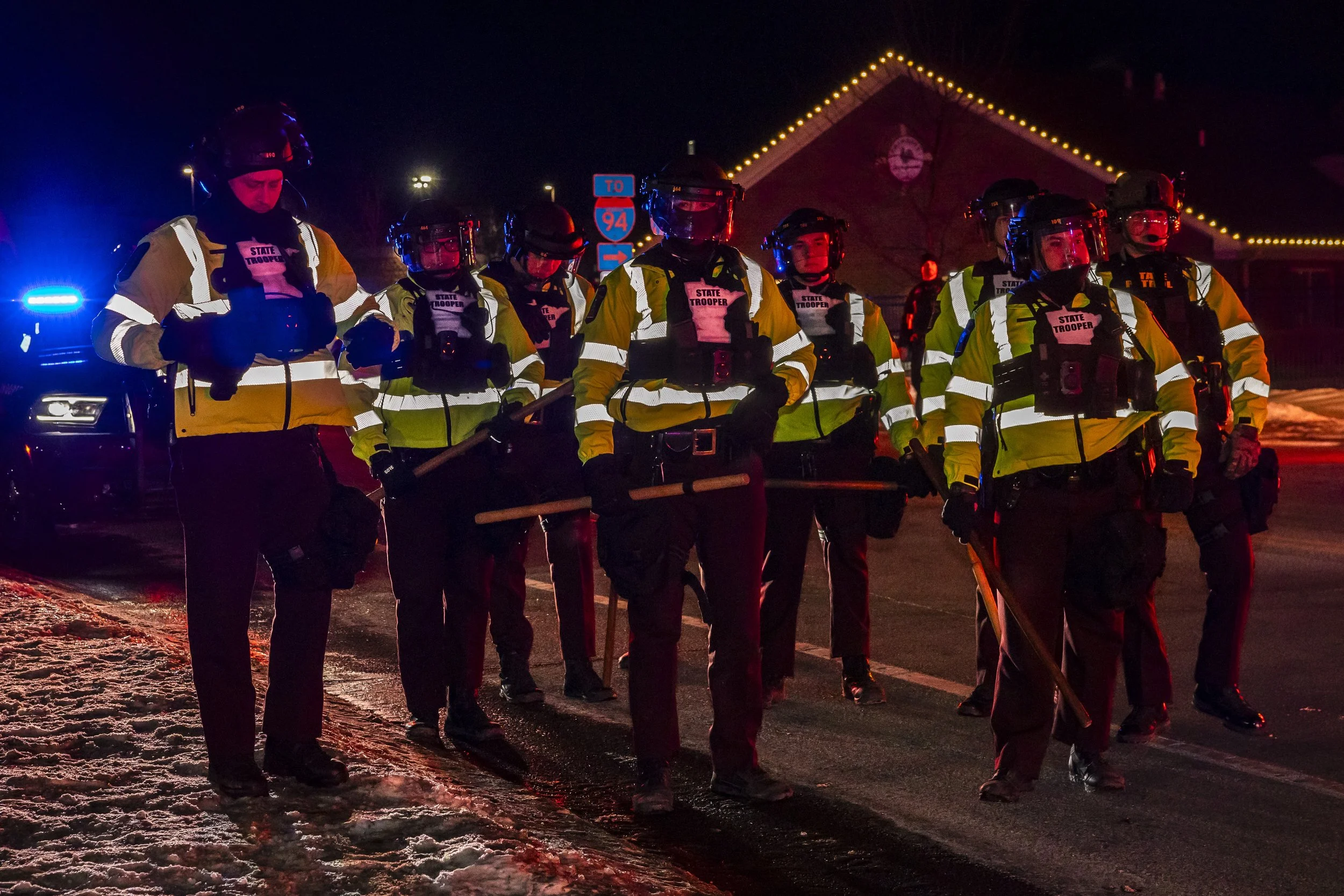
To my camera’s disappointment, there wasn’t much of that at the Hampton. The crowd was smaller, and the powers that be felt it necessary to send fleets from the Maple Grove Police Department, Wright County Sheriff's Office and Minnesota State Troopers to address a scuffle with a meager dozen protesters.
In the face of an armada of law enforcement, a lone Minnesota man in a brown jacket refused to leave after being ordered to. He planted his feet, teal megaphone in one hand, purple vuvuzela in the other, and shouted “Accomplices!” at authorities, while police threatened to arrest him.
It happens often at Los Angeles protests: LAPD arrives dressed in riot gear, they form a human barricade, and then it's a flip of the coin on who starts the skirmish.
Patrick Henry’s Spirit
I didn’t get what I needed for a news article I’d envisioned about armed community patrollers, and it seemed too late to produce any meaningful work before my flight on Feb. 2; so, I dedicated Feb. 1 to meeting the locals one beer at a time.
For breakfast: two cigarettes, jerk chicken and a heavy-handed pour of rum punch from Pimento Jamaican Kitchen & Rum Bar on Nicollet Avenue in Minneapolis.
The owner, Michael Wilson, a charming man with a captivating smile and even better food, served the table himself. He gave us free coco bread and a small serving of curry goat to pair, and it was delicious enough for me to return and risk almost missing my flight the next morning.
After shoveling my food down, I crossed Nicollet Avenue into The Copper Hen Cakery & Kitchen for a coffee with a shot of Jameson. One turned to two, and two turned into a full-blown conversation with an older woman sitting next to me at the bar.
We had a conversation on how Twin Cities residents are feeling cagey and distrustful of the press. From Los Angeles to Minnesota, it's a sentiment people often share, one that I don’t know how to change.
There are a lot of problems I don’t know how to fix. One of them is immigration.
I don’t know how to solve the immigration issues in America — revising our foreign policy and letting underdeveloped nations economically advance might work, or maybe a faster pathway to citizenship — but it sure as hell ain’t whatever the federal government is doing in Minnesota.
Two hours before my flight, I drove around Minneapolis with my foot floored on the pedal searching for a community patroller to answer a single question, but the most important one: “Considering everything that’s going on, do you think Minnesotans are winning their push back against ICE?”
“You’re damn right,” said Anastasia Bolton, a community patroller canvassing near Pretti’s memorial. “We only have us and we’ve only ever needed us, and that’s what’s scary to a system that tries to oppress us.”