
So What’s “The Drama”?
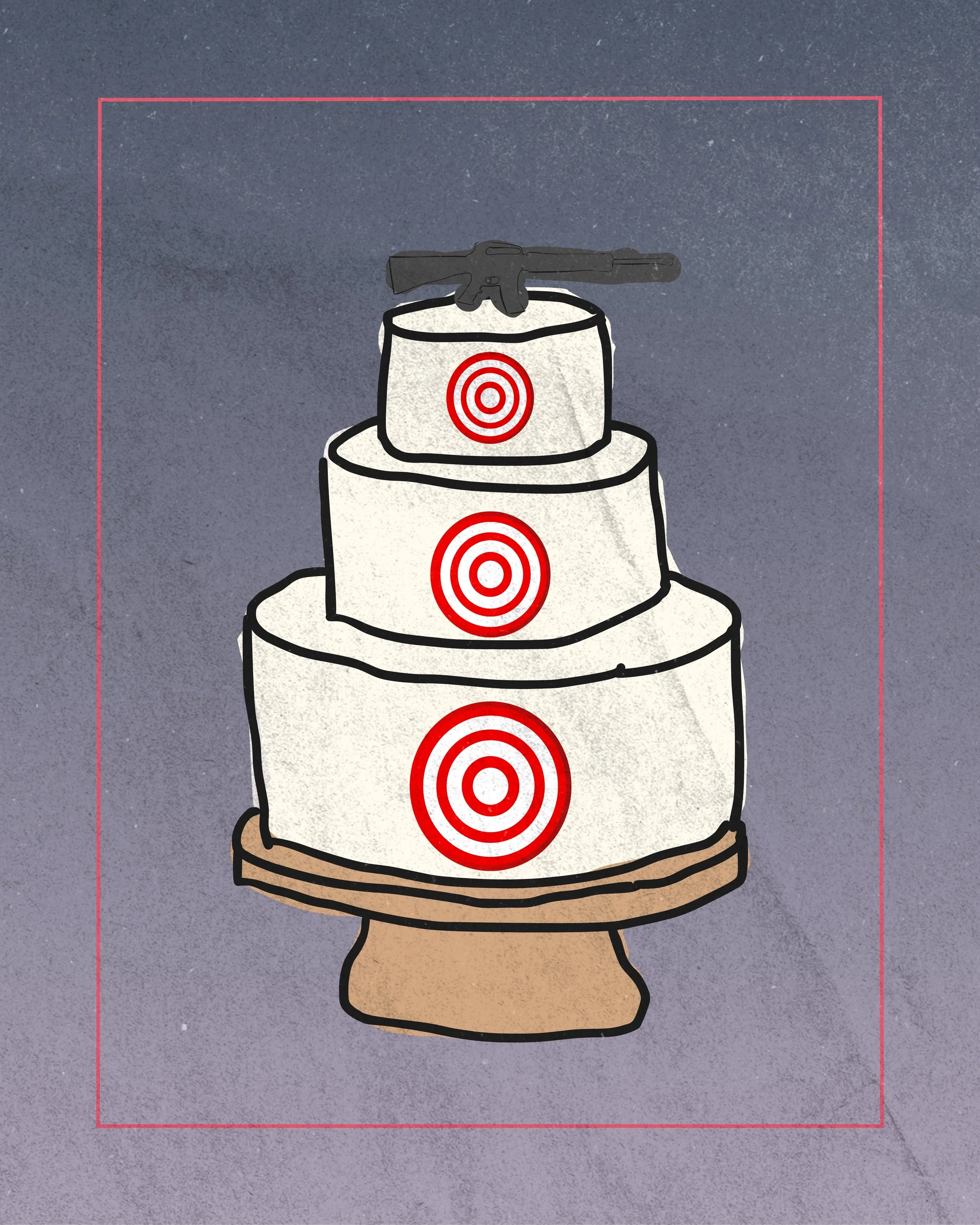
Graphic by Malaika Kamau
Jesse Rae’s “Inside Out” reverberates off the walls of a two-story Boston apartment. A groom sways with the loose abandon of a drunkard, hugging himself in the absence of a fairer partner. He is doing a concussion waltz. Face swelling — an angry bruise inflating the hollow of his eyes. Suit ruffled and stained in blood. The bride? Nowhere to be found.
You’ve been cordially invited to the wedding of Charlie Thompson and Emma Harwood.
Writer-director Kristoffer Borgli’s latest feature, “The Drama”, lowers us into a nuptial DEFCON 1.
There will be those who chafe against the manner in which the subject of mass shootings is handled. Viewing the film as an exploitation of the virulent endemic of gun violence within the U.S., this camp will bow out on the grounds of sensibility.
There will be others for whom personal experience makes it difficult to digest media that eddies the topic. There is merit to the claim that this issue deserved a more delicate touch.
While I am willing to concede to the legitimacy of these critiques, I am hard-pressed to call what “The Drama” does “empty provocation” and find that reading a reflexive unwillingness to engage with the material.
“The Drama” is in the lineage of the Socratic tradition, acting as a site of dialectic dilation.
To whom do we extend empathy? What are the limitations of that empathy? What can “excuse” an act deemed reprehensible and what does it mean to “excuse” one from their most wretched actions?
We fear the slippery slope of moral relativism; that we may lose ourselves and/or our virtue should we fail to properly punish the depraved. So saunters in the shopworn rhetorical question: Who exactly is qualified to assume the dignitary title of moral arbiter?
None of us is pure, but it is reasonably agreed that there is a gradient that separates the litterbug from the megalomaniacal genocidal dictator.
Often such talks devolve into these extremes, a dichotomy of innocuous not-great-behavior that could be dismissed with a finger wag and, well, evil (or at least what you and I — reader with a presumed Western upbringing — categorize as evil).
It becomes difficult to delineate actions that are closer in proximity on this scale.
How does one compare locking a child with disabilities in an RV overnight as he screams to be let out, to entrenching yourself in seedy online forums and using the information you compile to orchestrate, actively train for, and execute a mass school shooting?
Correction: Almost execute a mass school shooting.
It’s a discussion of measurable harm versus the potential devastation born from deranged adolescent fantasy. What stops Emma from following through is witnessing the fallout of the latter.
There is an argument to be made that there was a lack of nuance and dimensionality to Emma’s Blackness. On the other hand, seeing as the narrative is predominantly conveyed through Charlie’s spiraling, Emma isn’t given much interiority anyway.
To hear that a woman of color has been sidelined in favor of her white lead might prompt us to mutter the refrain “tale as old as time”; however, I feel that this minimizing of Emma mimics the vampiric transformation she undergoes in Charlie’s mind post-confession and her rapid othering.
Whether intentional or not on the part of the Norwegian director, by virtue of the socioracial dynamics we occupy in the United States, a woman of color being denied grace from those around her sustains a charged undercurrent.
Still, if written by a Black person — ideally, a Black woman — Emma’s psychological profile as a brown girl growing up in the limbo that befalls an army brat and the loneliness that encrusts, might’ve landed with more resonance.
This branches into the larger conversation of whether characters of marginalized identities should be written exclusively by minority writers. I say: Of course not, with the asterisk that there will always be the risk of something getting lost in translation, even if the utmost care and consideration are taken.
The editing of “The Drama” has the sleight of hand of a seasoned illusionist shuffling a deck of cards, with its blink-and-you-miss-it re-contextualizations.
The psyche of its characters is imprinted onto the edit, which turns with the associative tide of thought and breath — alive, electric. Charlie’s obsession, anxiety and runaway paranoia are felt as our own.
Charlie Thompson is a bespectacled nebbish, a “weird little British freak.” The kind of man with an undeniable baby-girlism that obfuscates the consequences of his cowardice. He triggers a very specific cuteness-aggression. Though for many, this may just be flat-out aggression-aggression. Wanna-punch-my-laptop-when-he’s-on-screen-now-that-this-is-out-on-digital aggression because your fiancé is Zendaya, which disqualifies you from ever voicing another complaint in this life.
“It should’ve been me,” we all say in unison.
Paraphrasing a quote from Freud, Charlie summarizes the mythos that pumps through this film’s arteries: “Unexpressed emotions will never die. They are buried alive and will come forth later in uglier ways.”
With no direct victim, it’s unclear who suffers from Emma’s thoughtcrime. How much repentance grants absolution from such a sin?
“The Drama” is a thought experiment in motion, comparable to a performance piece that cannot function without audience participation. It’s the stuff of heated filibusters between friends and family, argued with the fevered passion of a jury deliberating a murder case.
There can never and will never be a consensus. For some, Emma is irredeemable. For others, her heel turn into advocacy is admirable. And for a percentage of viewers, her character may lurk in that marsh of gray ambiguity.
If the text of “The Drama” could be flipped over to reveal a Scantron key of correct moral takeaways and vindications, it would’ve been a thematic miscarriage on the part of Borgli, one that was skirted in favor of something polarizing yet substantive.
For Gen Z, a demographic with a neurotic fixation on moral hygiene, it fits that “The Drama” would capture our ethical imagination. I get the sense that when talking about this film, we’re all playing our own defense attorney, representing ourselves in the court of good-personhood.
We’re sitting in on that wine tasting dinner, being asked “what’s the worst thing you’ve ever done?”, too scared to wonder what it might mean if we’re beyond forgiving.