
SMC equity efforts undercut by English tutor layoffs

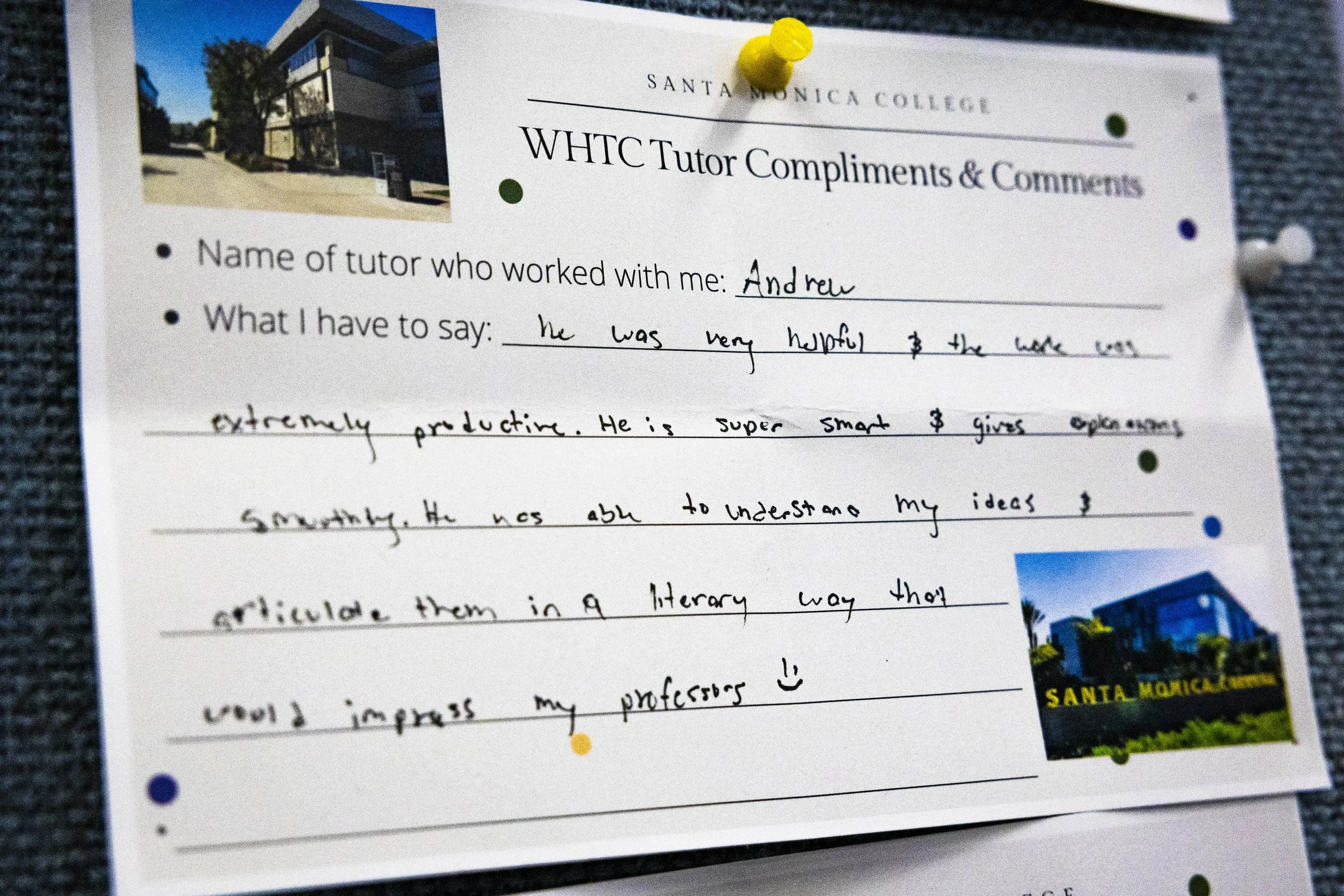
Inside Santa Monica College’s Writing & Humanities Centers hangs a board on the wall full of compliments from students who felt lost, stuck or anxious until they meet with an instructional tutor. This month, the college plans to lay off four of them.
The Board of Trustees adopted a resolution to eliminate 57 classified — or non-academic — jobs and four management positions to address its budget crisis on Feb. 3. SMC’s WHTC expects to lose four instructional tutors, according to the center’s tutoring coordinator, Loretta Huizar.
SMC will notify laid-off employees on March 15, according to an emailed Feb. 4 memo from Superintendent and President Kathryn Jeffery to the campus community. Layoffs begin July 1, according to a notice sent on Jan. 29 from Jason Beardsley, vice president of Academic Affairs, to multiple workers being considered for release.
The Corsair contacted Beardsley for an interview, but as of publication he has not responded.
Seven instructional tutor positions will be eliminated, along with several others from counseling services, maintenance and the SMC Police Department, the Feb. 3 meeting agenda states.
“If these layoffs go through, and the people who have been planned to be laid-off are cut, the center is going to be understaffed, underfunded and basically crippled from the get-go,” said Andrew Liu, a part-time adjunct professor and instructional tutor at SMC, who received a layoff notice.
“We won’t be able to have any workshops. We won’t be able to have any development. It’s just going to be like half of what we’re doing right now, and it’s not going to be effective,” Liu said.
The WHTC employs 10 part-time instructional tutors who each work 20 hours a week, Huizar said. The center offers one-on-one tutoring in several humanities subjects — such as English, Philosophy and History — and a variety of workshops and assistance with the college transfer process. But the center is already understaffed, according to Wendi DeMorst, associate dean of Student Instructional Support.
Students often go to the WHTC because they consider it a safe space where they feel supported, said DeMorst, one of four managers who received a layoff notice. Besides needing longer hours, there haven’t been many complaints about the center, she added.
DeMorst said it would be a “tragedy for students” if tutors are laid off, because they wouldn’t receive the support they require.
“Having the WHTC that’s connected to the actual professors and classes that are on campus makes a huge difference,” DeMorst said. “(Students) are able to work with professors, find out what those assignments are, see where students may be struggling, and where we need to give them support, and that’s worth gold.”
The WHTC’s busiest time of the year is transfer season, and from the middle of the semester onwards, said Sarah Beth Rapson, an instructional tutor at SMC who also received a layoff notice after nine years.
In November, tutoring schedules are full because transfer essays are due and other academic deadlines approach. “That’s when we get busiest, and that’s what we help with the most: resumes, transfer essays, homework assignments, a lot of essays,” Liu said.
In fall 2025, WHTC tutors completed 843 on-campus appointments and had 120 no-shows, according to records viewed by The Corsair from SMC’s tutoring system, WC Online.
Between fiscal year 2024 and 2025, WHTC tutors completed 3,521 appointments, not including peer review visits, workshops and other requests from instructors, Huizar said in an emailed statement.
The role of a writing tutor is to be a supportive partner who encourages students, Liu said.
“When you have students coming in here with great ideas, great voices, important experiences, things to say, voices to be heard, you really want to do your best to help them and to remove all the barriers that are in their way,” he said. “Because there are countless barriers that are in place.”
One such barrier is English 28, or Intensive College Writing Skills, a course that has remained largely unchanged since its 2018 launch and needs an urgent redesign, according to the 2025-28 Student Equity Plan. The English department developed this corequisite support course in accordance with Assembly Bill 705, which passed in 2017. The law requires community colleges to “maximize the probability” that a student will complete their required-for-transfer math and English courses within a year, using high school records as placement tests.
Although English 28 is intended to close equity gaps and assist students with ENGL C100, formerly known as English 1, Black and Latino students completed English 1 at rates of 45% and 46%, respectively, compared to a 67% completion rate for white students, according to completion data from 2018 to 2024 fall terms in the 2025 SEP.
“This overrepresentation points not to student deficits, but to the inadequacy of current structures in meeting the needs of racially minoritized students. Like most courses at SMC and across higher education, English 28 was initially developed within a default course design framework shaped by dominant cultural norms and white-centered pedagogical assumptions.
“As a result, the course may unintentionally overlook the linguistic, cultural, and racialized experiences of the very students it aims to support,” the 2025 SEP states.
SMC has had a lackluster response to AB 705 compared to other community colleges, according to the 2022-2025 SEP. The college’s large-scale student support efforts over the last four years — such as Student Care Teams and Peer Navigators — don’t focus on supporting Black and Latino students, the SEP states.
The English department is also fatigued and has less of a desire to utilize support services within the classroom, the SEP states. This is because SMC’s mission is not student-centered, some faculty have the mindset that half-baked interventions are more of a burden than effective practice, and support for tutoring and student services is minimal and poorly communicated, according to the SEP.
SMC’s Equity, Pathways and Inclusion Working Group developed the 2025 SEP with money from the California Community College’s Student Equity and Achievement Program, the SEP states. To receive the funds — and follow California Education Code 78220-78222 — colleges must ensure equal educational opportunities and promote success for all students.
“Advancing equity is not optional — it is our mandate,” the 2025 SEP states. The Board of Trustees approved the SEP Dec. 2, 2025.
According to DeMorst, some faculty have complained to her about English 28’s effectiveness, but the WHTC, Supplemental Instruction program and other tutoring centers on campus have all been constant sources of student support.
Historically, teachers recommend — and some at SMC even require — students to attend tutoring because it’s beneficial and develops productive habits, said Wilfred Doucet, a tenured English professor who’s worked at SMC for 29 years.
“Excellence is never achieved in isolation,” Doucet said.
“Writers really should get some feedback on their writing, because it helps a writer see things that they miss,” he added. “Not just any fresh eyes, but eyes that are informed about what one is doing and have some experience, some knowledge, have demonstrated some mastery of writing. It’s a habit of A-students to get feedback on essays.”
Students often enter college underprepared or struggling with their confidence, and part of being a professor is building a student’s self-worth and helping them realize that they have the ability to achieve their goals, Doucet said.
But tutors can also play a role in a student’s development. “I don’t care that I’m the professor, that I’m the expert,” he said. “None of us can think of everything, and so getting those other eyes on it really does matter.”
DeMorst said tutoring is the next available option if a student doesn’t feel comfortable around a professor or needs additional support.
“I’ve seen students who completely don’t get material, and then we talk, and just by talking, they get a path forward,” Liu said.
“We get to the root of their anxiety, and then all I have to do is say, well, if you look at it that way, of course, that’s going to cause you a lot of anxiety. But if you look at it another way, if you get just a simple plan in place for starting the essay, for organizing your ideas, you’ll see that those anxieties will kind of float away,’” he said.
Writing tutors also help with a lack of motivation, clarity when choosing a four-year university and, for some students, “trouble brewing at home,” Liu said.
For students looking to attend a four-year university, Rapson and Huizar piloted an Open Transfer Lab in coordination with the Transfer Center in fall 2024. At the lab, Rapson assists students with the application process as a specialist.
But if Rapson is laid off, it’ll add additional strain to the Open Transfer Lab, Huizar said.
According to Rapson, it took years to pilot the Open Transfer Lab because SMC is a bureaucracy, so it takes a while to authorize student-centered initiatives.
“It’s really ironic that they’re doing this so quickly, because we’ve tried for years to help our students, and then in one fell swoop they’re just bringing the axe down on all of us,” she said.
Aside from the employees and managers who are being released, Black and Latino students are going to be first and most impacted by the possible layoffs, DeMorst said.
SMC has multiple initiatives — such as Student Equity, Outreach and Special Programs — to bridge equity gaps, but there’s a lack of shared institutional ownership for equity work, resulting in uneven accountability and slowed progress toward systemic change, the 2025 SEP states.
Associated Student President Ailsa Ortiz said, budget cuts are necessary, but SMC’s possible layoffs are hurting the communities that are used to “getting the short end of the stick.”
The WHTC, like other tutoring centers at SMC, is a vital part of instruction, Doucet said. “To lose them or to in any way minimize what they’re able to do is ultimately a disservice to our students,” he added.
“That’s supposed to be number one priority: student success and what we can do to help our students succeed, and especially those most in need,” Doucet said. “We’re here to serve them.”
The next trustee meeting is on Tuesday, March 3. Ortiz said she believes students need to put more pressure on administrators and executives because they should have prevented and foreseen SMC’s budget crisis.
“They’ve been so complacent and comfortable that we’ve gotten to these points,” she said. “If we put fire under the executive and administrative seats, we can start to hold them accountable for their stewardship of the institution.”